Turning 40 doesn’t mean your metabolism has betrayed you. Research reveals calorie burn stays surprisingly steady until 60, so why does weight loss feel so much harder? The real culprits might surprise you.

Key Takeaways
Metabolism does not suddenly collapse at 40; research on daily energy use stays fairly stable from the 20s through the 50s once body size and composition are accounted for
Muscle loss, shifting hormones, poor sleep, stress, and certain medications are the real forces that make weight management feel harder in midlife
A controlled pace of about 1 to 1.5 pounds a week, paired with protein-forward meals and strength training, protects muscle while body fat comes down
Crash dieting after 40 tends to backfire by triggering muscle loss and rebound hunger - a gentler, more consistent approach holds up better over time
An identity-first approach, including the idea of resetting the Identity Thermostat, reframes slip-ups as data instead of personal failure
Turning 40 often comes with a nagging suspicion that the body has quietly turned against its owner. The scale moves slower, old diets stop working the way they used to, and frustration builds fast. The good news is that the story is more nuanced than a sudden metabolic crash, and understanding what is actually happening opens a calmer, more effective path forward.
The Truth About Metabolism at 40
A popular belief says metabolism falls off a cliff the moment a birthday candle gets blown out at 40. Research on total daily energy expenditure tells a different story: calorie burn, once body size and composition are factored in, tends to stay fairly steady from the 20s all the way through the 50s, with a more noticeable decline typically showing up later, around 60. The sense of a sudden midlife metabolic collapse does not hold up against that data.
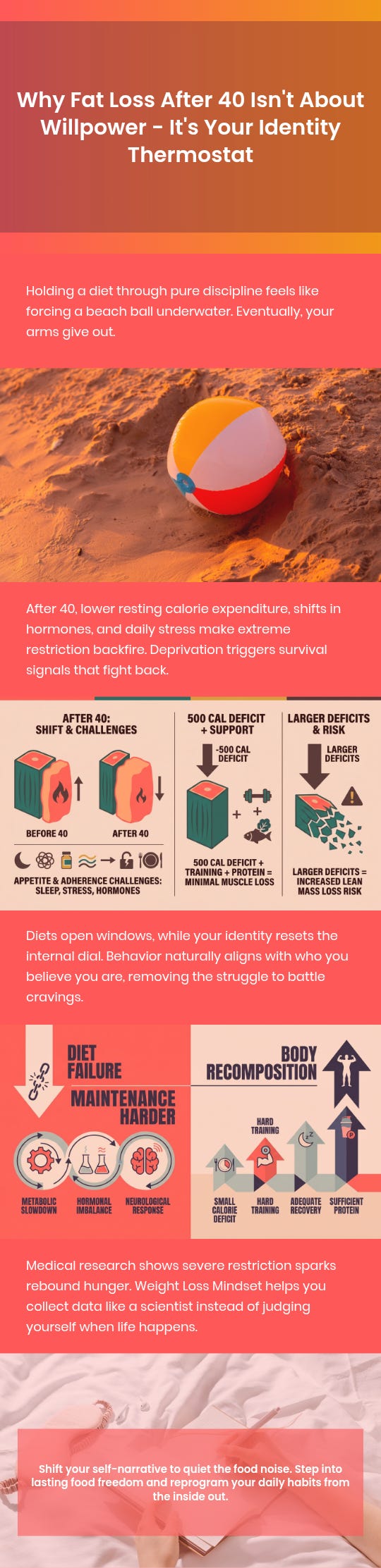
What changes instead is more layered and more fixable. Muscle mass, hormone patterns, sleep quality, stress levels, and even medications shift gradually over the decades, and together those changes can make the body burn slightly fewer calories at rest while also making consistency harder to maintain. This shift can be framed through the idea of an Identity Thermostat: lasting change comes from resetting self-identity rather than white-knuckling through another restrictive plan.
This reframing matters because so many people over 40 carry years of self-blame from diets that failed them, not the other way around. Recognizing that the body’s wiring has changed, rather than assuming personal willpower has gone missing, is the first step toward a plan that actually holds up.
What Actually Changes In Midlife
Several interconnected shifts happen quietly in the body during the 40s and 50s, and understanding each one helps explain why old strategies stop producing the same results.
Muscle Loss and Resting Calorie Burn
Muscle tissue burns more energy at rest than fat tissue does, so when muscle mass declines, resting calorie burn tends to follow it down. Physical inactivity can be accompanied by losing 3% to 5% of muscle mass each decade after age 30, according to the University of Maryland Medical Center, and that steady erosion compounds over time if nothing is done to counter it. A higher proportion of body fat relative to muscle lowers overall calorie burning, since fat tissue is less metabolically active than lean tissue.
This is not an inevitable slide. Muscle responds to use at any age, which means the loss can be slowed, stopped, or even reversed with the right kind of training.
Hormones, Perimenopause, and Appetite
For many women, perimenopause often begins in the 40s, and the hormonal shifts that come with it can affect appetite, hunger cues, and how the body manages weight. These changes do not affect everyone the same way, and genetics play a role in how noticeable the shift feels. For men, hormonal changes tend to be more gradual but can still influence energy levels and body composition over time.
Appetite regulation becomes a bigger piece of the puzzle in midlife than it was at 25. When hunger signals feel less predictable, cravings and portion control naturally become harder to manage through sheer discipline alone.
Sleep, Stress, and Medications
Poor-quality sleep, ongoing stress, certain medications, and menopause-related disruptions commonly show up together after 40, and each one can chip away at the ability to manage weight consistently. Sleep problems in particular tend to cluster with other midlife changes, making a regular sleep routine one of the more overlooked tools for weight management. Chronic stress adds another layer, since it can affect both appetite and the motivation needed to stick with new habits.
Medications prescribed for common midlife conditions can also influence weight, which is worth discussing with a doctor rather than assuming diet alone is to blame. These factors tend to stack rather than act alone, which is part of why weight loss after 40 can require more strategy than it used to.
The Real Cost of Crash Dieting
Severe calorie restriction might produce a dramatic number on the scale in the short term, but it often comes at the expense of muscle tissue, the very thing that needs protecting most in midlife. When the body is starved of calories, it pulls energy from wherever it can, including lean muscle, which then lowers resting calorie burn even further. This creates a frustrating cycle where each restrictive diet makes the next one harder to succeed at.
Crash diets also tend to trigger a rebound effect once normal eating resumes. Hunger hormones spike, cravings intensify, and the weight that came off quickly often returns just as quickly, sometimes with extra pounds attached. Rather than treating a slip back into old patterns as a personal failing, it helps to recognize restriction itself as the design flaw. A pattern of yo-yo dieting over the years is one of the most common reasons people over 40 feel like their metabolism has betrayed them, when the deeper issue is a string of plans that were never built to last.
A Realistic Pace: 1-1.5 Pounds a Week
A controlled, steady pace of weight loss protects muscle, supports energy levels, and is far more likely to stay off long term. Mayo Clinic points to cutting roughly 500 to 750 calories a day as a way to support a loss of about 1 to 1.5 pounds per week, a modest deficit that avoids the extreme hunger and fatigue that often derail bigger, faster cuts.
This pace might feel slow compared to dramatic before-and-after promises, but it reflects how the body actually responds to lasting change. A few practical guardrails make the difference between a plan that works and one that collapses within weeks:
Track food intake for a week or two to reveal hidden calories from drinks, sauces, oils, and absent-minded bites
Expect a larger drop in the first week or so due to water and glycogen shifts, and do not mistake that for the long-term pace
Adjust the deficit if sleep worsens, hunger becomes constant, or strength in workouts starts to decline
The goal is progress that can be maintained for months, not a number that looks impressive for a single weekend.
Protecting Muscle Through Strength Training
Since muscle loss is one of the main reasons resting calorie burn declines with age, protecting and building muscle becomes one of the most valuable tools available after 40. Strength training using weights, resistance bands, or body weight exercises can help counter this decline, with general guidance suggesting at least two sessions a week on nonconsecutive days to give muscles time to recover and rebuild.
Consistency here matters more than intensity. A well-structured, moderate routine performed regularly tends to outperform an occasional intense workout that leaves someone too sore or discouraged to continue.
Protein-Forward Meals
Protein plays a direct role in preserving muscle during weight loss, which is part of why meals built around it tend to produce better long-term results. One nutrition guide suggests aiming for about 20 to 30 grams of protein per meal, spread across the day rather than loaded into a single sitting, to support muscle maintenance while the body is in a calorie deficit.
Practical sources include eggs, Greek yogurt, fish, poultry, tofu, lean meat, and legumes, all of which can anchor a meal while also improving satiety. Feeling fuller for longer after a protein-forward meal naturally reduces the mental battle against hunger later in the day.
Daily Movement Beyond the Gym
Formal workouts matter, but daily movement outside the gym adds up in ways that are easy to underestimate. Breaking up long stretches of sitting with short walks, taking the stairs, or simply standing more often throughout the day all contribute to overall energy use. NIH News in Health points to daily walks and interrupting long sitting periods as practical, low-barrier ways to stay active as routines naturally shift with age.
This kind of movement requires no gym membership or rigid schedule, which makes it one of the more sustainable pieces of the puzzle for people juggling work, family, and the general busyness of midlife.
Treating Slip-Ups as Data, Not Failure
One of the most damaging habits in traditional dieting is treating every slip as proof of weakness. A missed workout, a bigger-than-planned dinner, or a stretch of poor sleep gets filed away as evidence that the plan, or the person, has failed. This mindset usually does more harm than the slip-up itself, since it tends to trigger a spiral of guilt that makes giving up feel easier than continuing.
Weight Loss Mindset built its coaching approach around a different framing, encouraging people to act as scientists rather than judges when something does not go as planned. A missed strength session is simply information about what got in the way, whether that was poor sleep, a stressful week, or an unrealistic plan to begin with. Looking at a slip-up this way keeps motivation intact and makes it far easier to adjust and keep moving forward, rather than abandoning the whole effort over a single rough day. This shift is central to escaping the cycle of repeated diet attempts that so many people over 40 already know all too well.
Weight Loss After 40 Is Still Possible
None of the midlife changes described here, from muscle loss to hormonal shifts to disrupted sleep, make weight loss impossible. They simply mean that extreme restriction and guilt-driven discipline work less well than they may have decades earlier. A steady pace, muscle-protective habits, and a more forgiving mindset toward setbacks tend to produce results that actually last.
Progress after 40 often looks different than it did at 25, showing up as improved strength, better-fitting clothes, and steadier energy rather than a dramatic number on the scale in week one. For anyone ready to build sustainable habits instead of chasing another quick fix, a weight loss mindset reset can offer a practical starting point grounded in how the body and mind actually respond to lasting change.