Countdown timers, “miracle” ingredients, 30 pounds in 30 days - weight loss ads are designed to short-circuit your judgment. The FTC flags three lies that show up again and again. Do you know how to spot them before you pay?

Key Takeaways
Programs promising rapid weight loss without any medical oversight, hidden ingredients, or urgent countdown timers are common red flags worth walking away from
The Federal Trade Commission has flagged false promises like losing weight without dieting or exercising, or dropping 30 pounds in 30 days, as classic warning signs to watch for
Extreme restriction and yo-yo dieting can trigger fatigue, nutritional deficiencies, and a rebound effect that leaves people heavier than before
An identity-first approach, as taught by Weight Loss Mindset, treats slip-ups as data instead of moral failure, shifting focus away from willpower and restriction
A later section breaks down what separates a transparent, sustainable program from one built to keep customers cycling back
Signing up for a new weight loss program can feel like stepping into a maze. Flashy promises, countdown clocks, and “guaranteed” results all compete for attention, making it hard to tell a genuinely helpful program from one designed to drain a wallet. Learning to spot the warning signs before handing over a credit card number can save months of frustration and protect both health and budget.
The FTC’s Three Weight Loss Lies
The Federal Trade Commission has spent years tracking misleading weight loss advertising, and a pattern keeps showing up. According to the FTC, three claims appear again and again in deceptive ads: losing weight without dieting, losing weight without exercising, and losing a dramatic amount of weight, such as 30 pounds in 30 days, regardless of what a person eats or how much they move. These claims sound appealing precisely because they promise an escape from effort, but biology does not work that way.
Any program leaning hard on one of these three claims deserves a second look before enrollment. Legitimate weight loss support can make the process easier, calmer, and more sustainable, but no honest provider can promise a number on the scale without some form of change in behavior, mindset, or habits. Recognizing this pattern is the first filter worth applying to any sales page, video ad, or social media post selling a weight loss solution.
Red Flags That Signal Danger
Beyond the FTC’s big three, a handful of specific warning signs tend to show up repeatedly across risky programs. Spotting these early can prevent wasted money and, in some cases, real harm to health.
Rapid Results Promised Without Oversight
Losing weight quickly sounds exciting, but medical experts generally consider losing more than one to two pounds per week to be an unsustainable pace for fat loss. Weight that disappears faster than that is often water and muscle, not fat, which means it tends to come right back once normal eating resumes. A program promising rapid results with no mention of medical oversight, screening, or professional guidance should raise immediate concern, since safe, fast weight loss is typically something that happens only under a doctor’s supervision for specific medical reasons.
Prepackaged Meals, Pills, or Single-Food Rules
Programs built around expensive prepackaged meals, proprietary shakes, or pills frequently lock customers into ongoing purchases rather than teaching skills that last. Diets that restrict eating to a single food group, such as cabbage soup, grapefruit, or a narrow list of “approved” items, follow a familiar fad-diet pattern that can be harmful over time. These setups often look convenient on the surface, but they rarely teach anything about managing real-world meals, restaurants, or holidays, which means the old patterns tend to return the moment the packaged food runs out.
Hidden Ingredients and Unregulated Supplements
A program or product that refuses to list full ingredient details is one of the clearest signs something is being hidden. Dietary supplements are regulated by the FDA, but unlike medications, they do not require pre-market review or approval by the FDA before being sold, which means some supplements sold for weight loss may be unsafe or simply ineffective. Marketing language built around “miracle” ingredients, thermogenic fat burners, metabolism boosters, or detox formulas deserves skepticism, since these claims often outpace the actual evidence behind them.
Urgency Tactics and “Guaranteed” Claims
Countdown timers, “only 3 spots left” banners, and aggressive limited-time pricing are designed to short-circuit careful decision-making. Legitimate programs rarely need to pressure someone into signing up within the hour. Weight loss scams have also grown more sophisticated on social media, using fake celebrity endorsements, AI-generated videos, misleading before-and-after photos, and fabricated medical claims to create false urgency and false trust. A program that pairs “guaranteed” results with a ticking clock is worth closing the tab on.
Why Quick Fixes Fail Long-Term
Understanding why fast-fix programs tend to collapse helps explain why red flags matter so much in the first place.
The Yo-Yo Dieting Cycle
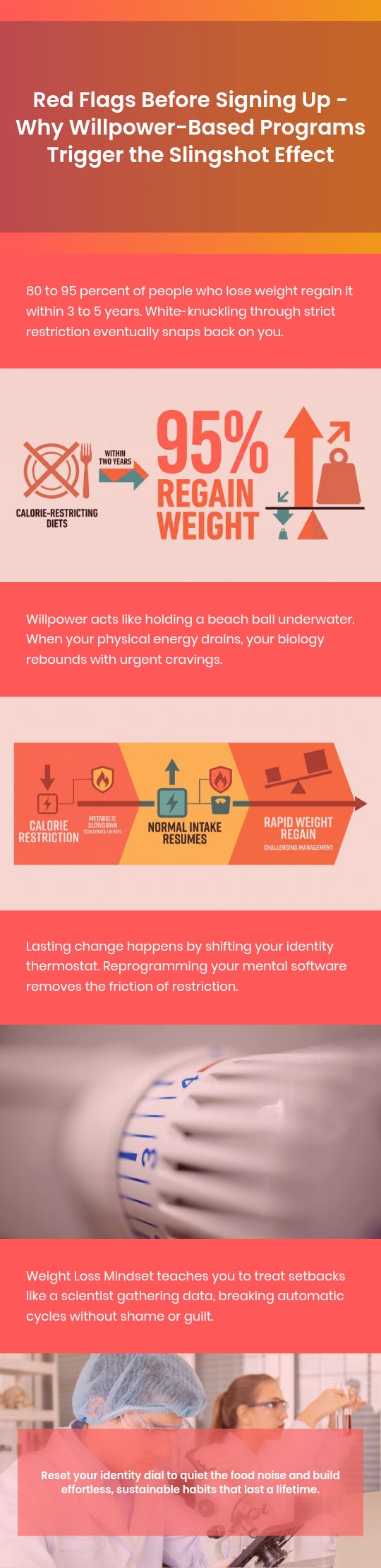
Quick-fix diets often produce short-term results followed by rapid weight regain, a pattern commonly called yo-yo dieting. The emotional toll compounds over time, since repeated cycles of losing and regaining weight often leave people more discouraged and more distrustful of their own ability to change.
Extreme Restriction’s Physical Toll
Severely cutting calories can trigger fatigue, muscle loss, and nutritional deficiencies. The body responds to extreme restriction by slowing down and conserving energy, which often leaves a person feeling sluggish and unmotivated rather than energized. Diets that eliminate entire food groups, such as all carbohydrates or all fats, carry their own long-term risks, including nutritional imbalances that build up gradually and go unnoticed until they cause real problems.
Ignoring the Real Reasons Behind Weight Gain
Most quick-fix diets treat weight as a simple math problem of calories in versus calories out, while ignoring the deeper reasons someone turns to food in the first place. Poor eating patterns, inactivity, emotional eating, and genetic predispositions all play a role, yet a meal plan or pill cannot address any of them. Many programs quietly set customers up to fail this way: they treat the surface symptom while leaving the actual driver of the behavior completely untouched.
Warning Signs Inside the Program Itself
Some red flags only become visible after enrollment, once the day-to-day structure of a program reveals its true priorities.
Scale Obsession and Rigid Food Rules
Programs that encourage daily weigh-ins paired with anxiety over every fluctuation tend to create an unhealthy relationship with the number on the scale. Daily weight changes are frequently caused by hydration levels or hormonal cycles rather than actual fat loss or gain, so building an entire program around that number can mislead and discourage participants. Rigid food rules, obsessive calorie tracking, and excessive exercise requirements are also recognized warning signs that a program has crossed from structure into disordered-eating territory.
No Change Required to Habits or Mindset
Any product claiming significant weight loss with zero change to diet, activity, or daily habits deserves serious skepticism. Sustainable weight loss almost always requires some adjustment to how a person eats, moves, sleeps, or manages stress. Programs that skip this entirely, offering a pill or shake as a total substitute for behavior change, are selling a shortcut that biology does not support.
What a Sustainable Program Looks Like
Once the warning signs are clear, it becomes easier to recognize what a trustworthy program actually looks like from the outside.
Transparency Over Hype
Programs worth trusting tend to list ingredients, costs, and provider credentials clearly, without burying details in fine print. They avoid urgency tactics, limited-time countdowns, and vague promises, instead letting the actual content and track record speak for itself. A sustainable approach to weight loss generally favors gradual, permanent changes to lifestyle and eating habits, built around nutrient-dense food, consistent movement, adequate sleep, and stress management rather than a single dramatic intervention.
Identity-First Approaches Over Willpower
One of the more overlooked red flags in the weight loss industry is the assumption that failure always comes down to a lack of willpower or discipline. Weight Loss Mindset takes a different view, treating repeated diet failure as a sign of identity patterns and biological loops that were never taught, rather than a character flaw. Its “Scientists, not Judges” principle reframes a slip-up as useful data instead of proof of moral failure, which shifts the entire emotional weight of a setback. Programs that frame every stumble as a personal failing, rather than information to learn from, tend to keep people trapped in shame rather than helping them move forward.
Choosing Programs That Won’t Backfire
Red flags rarely show up in isolation. A program promising rapid results usually also hides its ingredients, pressures with urgency, and skips any real habit change, because these patterns tend to travel together. Reviewing a program against this checklist before signing up, rather than after a disappointing month or two, protects both time and money.
A few practical questions to ask before enrolling in any weight loss program:
Does the program promise results faster than one to two pounds per week without medical supervision?
Are ingredients, costs, and credentials clearly listed, or vague and hard to find?
Is there pressure to decide within a short countdown window?
Does the plan require eliminating entire food groups or eating only prepackaged products?
Is any attention paid to habits, mindset, or the reasons behind eating patterns, or is weight loss framed as pure willpower?
For anyone exhausted by diets that promised everything and delivered a rebound, an identity-based approach to lasting weight loss provides a different starting point, one built around changing the thinking behind the behavior rather than adding another restrictive rulebook.