

If you’re 50+ and stuck in the diet-relapse cycle, here’s why: 80% of significant weight loss gets regained within five years. It’s not willpower failing you, it’s biology. There’s a different reset that actually works

.Key Takeaways
Muscle loss, slowing metabolism, and hormonal shifts after 50 make traditional dieting harder to sustain, regardless of effort or discipline applied
Research from the National Institutes of Health found that 80% of people who lose significant weight regain it within five years, showing willpower alone rarely holds up long-term
Restrictive dieting can trigger a rebound pattern researchers describe as a psychological snap-back, where harder restriction brings stronger cravings back
Lasting change works better as an identity shift rather than a willpower contest, replacing self-judgment with curious, data-driven observation
Small, repeated shifts in self-image can reshape eating habits over time, and this piece walks through what that process looks like in daily practice
Turning 50 changes the rules of weight loss, and most people do not get the memo until they are standing in front of a mirror wondering why the old tricks stopped working. The same calorie-cutting, the same cardio, the same “just be good this time” mentality that worked in the 30s now produces frustration and fatigue instead of results.
Why Diets Stop Working After 50
Diets built on restriction were never designed for what happens to the body and brain after age 50. They assume a steady metabolism, predictable hunger signals, and a mind that can override cravings through sheer resolve. Those assumptions hold up less and less as the decades pass.
Weight Loss Mindset approaches this from a different angle, because founder Rick Taylar built his method around a different question entirely: instead of asking “how do I resist food better,” the better question becomes “who do I need to become so resisting isn’t the whole battle.” That reframing matters more after 50, when biology itself starts working against the old playbook.
The frustration many feel is not a personal failing. It is a mismatch between an outdated strategy and a body that has genuinely changed.
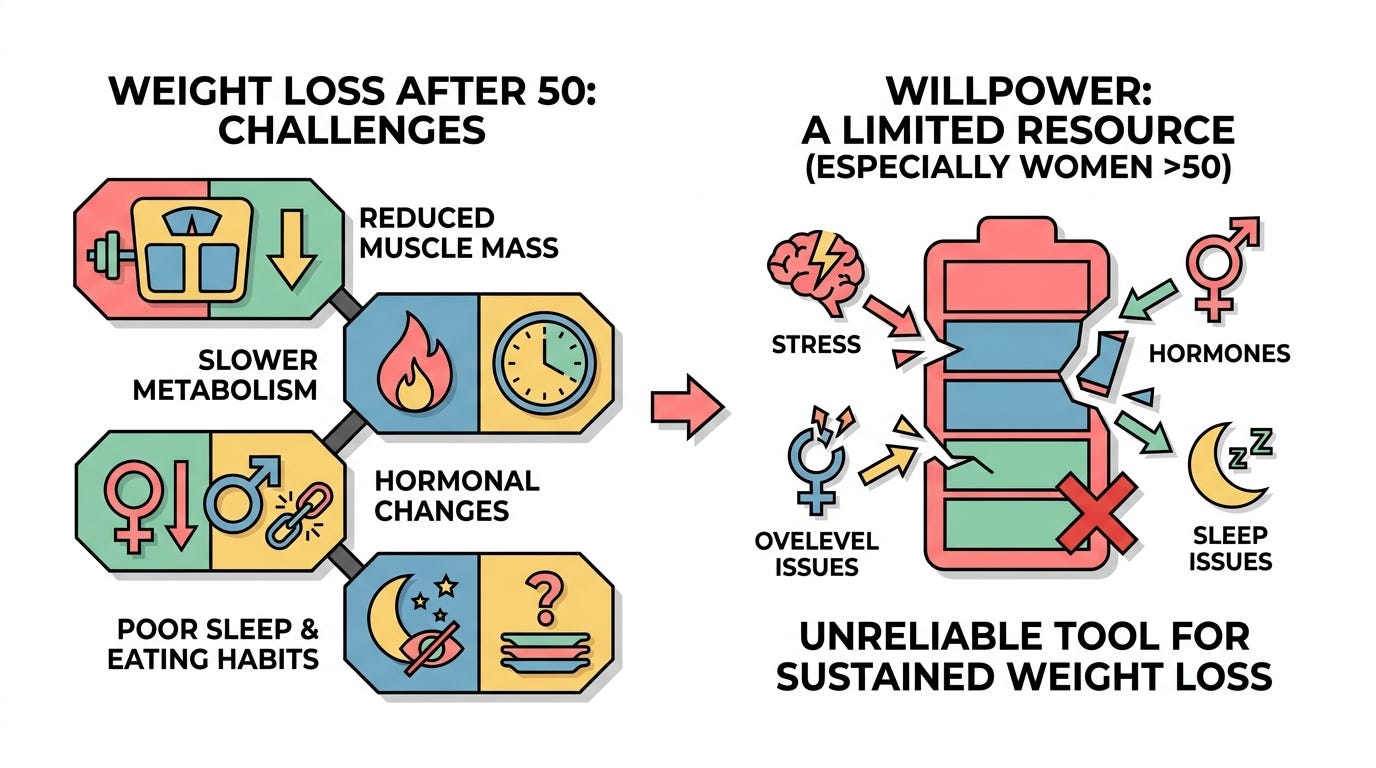
The Biology Working Against You
Weight loss after 50 involves real, measurable physical shifts, beyond the perception that things are harder now. Understanding what is actually happening inside the body makes it easier to stop blaming character and start addressing the real mechanics.
Muscle Loss and Slowing Metabolism
Muscle mass declines steadily with age, and that rate of loss speeds up after 50. Since muscle burns more energy than fat even at rest, this steady loss quietly drags metabolism down with it. Metabolism itself tends to stay remarkably stable from about age 20 to 60, provided muscle mass is preserved along the way; the real slowdown, of roughly 0.7% a year, does not usually kick in until after 60.
That distinction matters. It means the muscle-preservation habits built during the 50s can directly protect metabolic rate for the following decade. Strength-focused movement, adequate protein, and consistent activity do more here than any calorie-counting app ever could.
Hormonal Shifts and Fat Storage
Menopause and the years surrounding it bring a decline in estrogen that reshapes where the body stores fat, often shifting it from the hips and thighs toward the abdomen. This visceral fat carries higher health risks than fat stored elsewhere, which is part of why the scale and the mirror can tell two very different stories after 50.
Men experience a parallel shift as testosterone gradually declines, which can reduce insulin sensitivity and make the body more prone to storing fat rather than burning it. Both patterns point to the same conclusion: fat storage after 50 responds to hormonal signals, not just food choices.
Stress, Cortisol, and Hunger Signals
Chronic stress keeps the body locked in a low-grade survival mode, and the elevated cortisol that comes with it disrupts weight regulation on several fronts at once. It can slow metabolism, encourage fat storage, and scramble the hunger and fullness cues that normally tell the brain when to eat and when to stop.
Poor sleep, which becomes more common during perimenopause and beyond, compounds the problem by increasing hunger hormones. The body sends mixed signals at exactly the moment willpower is supposed to override them, a setup that explains why so many disciplined, hardworking people still find themselves stuck.
The Beach Ball Problem With Willpower
Willpower gets sold as the missing ingredient in every weight loss story, but treating it as the solution ignores how self-control actually behaves under real-life pressure. Self-control fluctuates with stress, fatigue, mood, and the everyday demands of a busy life, and once it dips, old patterns tend to reassert themselves fast.
Rick Taylar describes this concept through a simple image: willpower works like holding a beach ball underwater. The pressure builds the entire time it is submerged, and eventually the arms holding it down simply give out, not because the person was weak, but because that is what happens to anything held against constant resistance. The fix was never to grip harder. It was to stop fighting the water in the first place.
Why 80% of Weight Loss Gets Regained
The scale of this problem is not anecdotal. Research from the National Institutes of Health found that 80% of Americans who lose a significant amount of weight regain it within five years. That figure puts to rest the idea that regaining weight reflects a lack of discipline: when four out of five people who succeed at losing weight end up back where they started, the method being used to keep it off deserves more scrutiny than the person using it.
The Slingshot Effect of Restriction
Restriction does not create balance in eating habits. It creates tension, and tension built up over weeks or months tends to snap back with force. This slingshot pattern shows up constantly in diet culture: someone follows a strict plan for several weeks, feels proud of the control they are exercising, and then finds themselves eating in a way that feels completely out of their hands.
Physiologically, that snap-back has a clear cause. Hunger hormones spike and blood sugar crashes under sustained restriction, while deprivation itself reads to the brain as a threat to be resolved. The eating that follows works closer to physics than to a moral collapse, a predictable reaction to pressure that built up and had nowhere else to go.
Resetting Identity Instead of Restricting Food
If restriction reliably backfires, the alternative is changing what drives the behavior in the first place. Identity regulates far more than most people realize: habits, cravings, and daily choices are downstream of the story a person believes about who they are. Change that underlying identity, and the habits built on top of it tend to fall away without a fight.
This is the core distinction between a diet and an identity reset: a diet opens a window for a little relief, while an identity shift resets the thermostat controlling the whole room. One offers temporary comfort; the other changes the baseline. Lasting weight loss often requires becoming a genuinely different person, since the same person, with the same self-image, tends to eat the same way and regain the weight.
From the Judge to the Scientist
Much of the emotional exhaustion around dieting comes from a harsh internal voice that treats every slip-up as proof of failure. This inner “Judge” delivers verdicts, guilty, weak, hopeless, rather than useful information. Replacing that voice with the mindset of a Scientist changes everything about how a setback gets processed.
A Scientist collects data instead of delivering a verdict. A late-night snack becomes a clue about stress levels or sleep quality, not evidence of a broken character. This shift matters because shame tends to fuel the very behavior it is trying to punish, while curiosity opens the door to actually understanding what triggered the choice in the first place.
Interrupting Loops With the Circuit Breaker
Automatic eating patterns often run on a kind of mental autopilot, triggered by stress, boredom, or habit before conscious thought even gets involved. The Circuit Breaker provides a way to interrupt that loop in the moment it is happening, treating the urge to eat as electrical activity that can be paused rather than a command that must be obeyed.
This kind of mindfulness tool does not require heroic self-control. It creates a gap between the urge and the action, which is often all that is needed for the urge to lose its grip.
What Identity-Based Change Looks Like in Practice
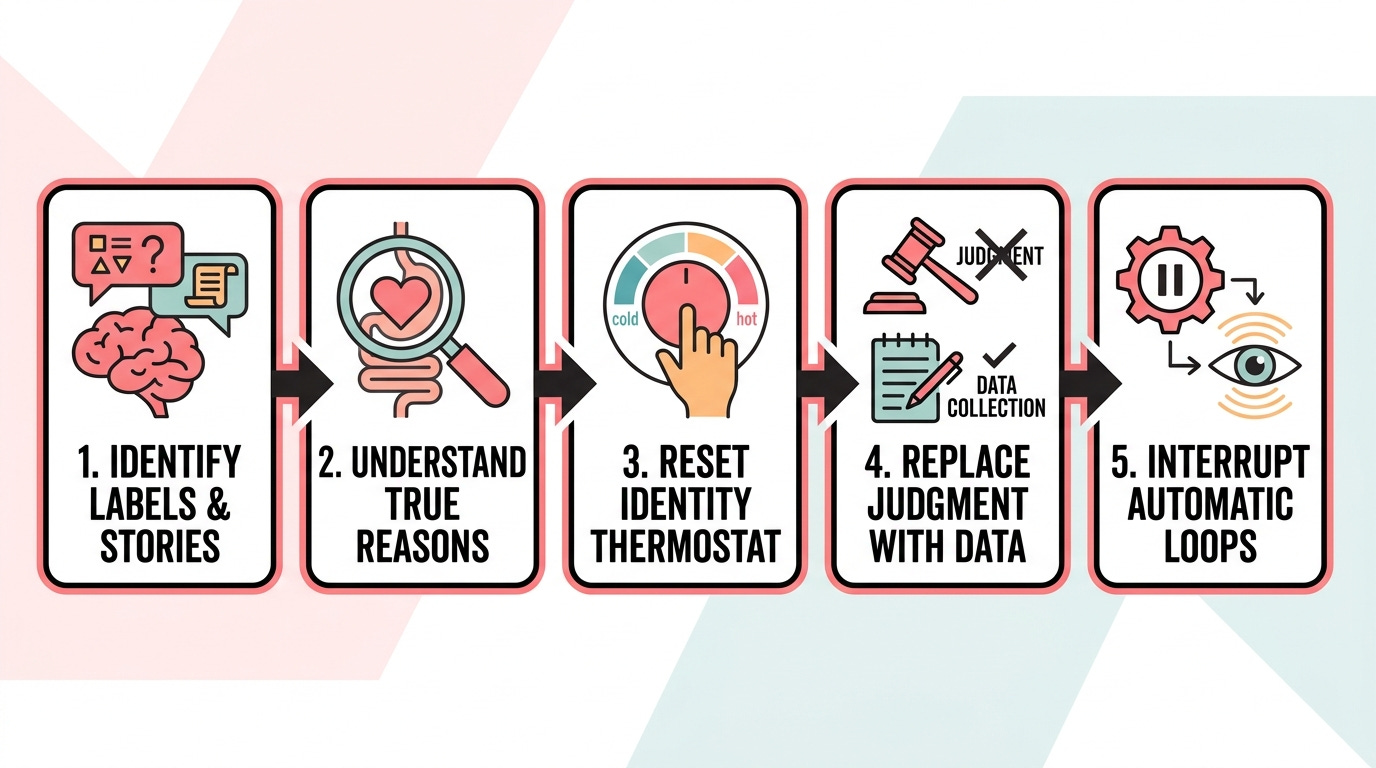
Identity change sounds abstract until it gets broken down into what actually happens day to day. The shift starts small, and it compounds the same way any repeated behavior does, through consistency rather than intensity.
Small Shifts That Reshape Self-Image
Redefining personal identity from someone “trying to lose weight” to someone who simply values and protects their health tends to drive behavior far more powerfully than any short-term goal. Each small, incremental choice reinforces that new narrative:
Choosing a walk after dinner because an active person naturally moves, not because a workout was scheduled
Preparing a nourishing meal because that is simply what this version of the person does, without framing it as a reward or punishment
Noticing a craving and responding with curiosity instead of alarm, treating it as information rather than a crisis
None of these actions require dramatic willpower. Each one is small enough to repeat consistently, and consistency is what turns a new self-image into a lived reality rather than a wish.
Real Stories of Lasting Change
Patricia, 55, lost 69 pounds and 25% body fat as a client of Precision Nutrition Coaching, a shift that changed how she saw her own body and her relationship with food. Tina, over 50, lost more than 40 pounds and kept it off with the help of Fit House, which helped her rebuild her metabolism and gain muscle, describing her turning point as recognizing she needed to care for herself before she could fully care for anyone else.
Beth V., a customer who worked through a 30-day identity-focused program, described a pattern that had defeated her for years: getting excited, going hard for a week or two, losing interest, and sliding back. This time, she completed every single day without missing an exercise, something she said was simply not like her. Long-standing eating habits she had carried for years were gone by the end, and she described feeling “free and light,” free enough that she kept going on her own well after the program ended.
You Are Not Broken, Just Hijacked
The most damaging idea in the diet industry is the quiet suggestion that struggling with food means something is wrong with a person’s character. That framing is false, and it is worth saying plainly: nothing is broken. What actually happened is a hijacking, biological loops involving hormones and metabolism, paired with psychological loops involving identity and habit, running silently underneath conscious awareness, never taught, and never interrupted.
Once those loops become visible, they stop having the same power. Seeing the mechanism is often enough to start loosening its grip, and that shift in seeing is where lasting change actually begins, not in another meal plan, but in a different relationship with the self doing the choosing.
For anyone ready to stop fighting biology and start working with it, an identity-based approach to weight loss provides a practical starting point built around how change actually sticks after 50.