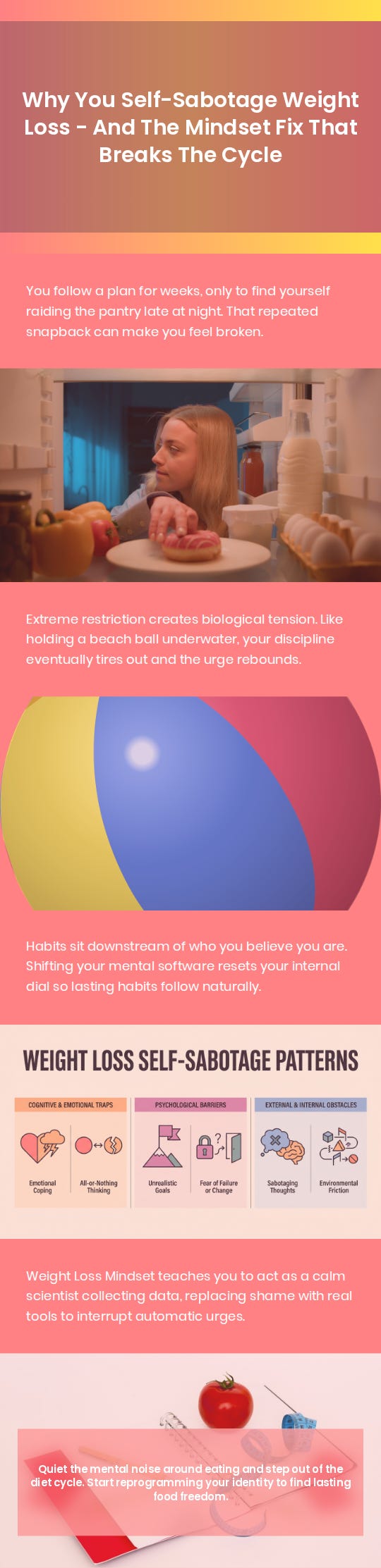
If you’ve regained weight after losing it, you probably assume willpower failed you. Three hidden psychological patterns actually drive the cycle, and once you spot yours, the regain stops feeling inevitable.

Key Takeaways
Weight-loss self-sabotage usually traces back to identifiable thought, emotion, and habit loops rather than a lack of willpower or discipline
All-or-nothing thinking turns one off-plan meal into a reason to abandon an entire day, while a simple recovery rule can stop that slide before it starts
A short food-and-mood log can reveal exactly which situations, feelings, or times of day trigger eating that has nothing to do with physical hunger
Restriction itself can intensify cravings and trigger rebound overeating, a pattern worth watching for in any plan that feels too rigid to sustain
Treating a setback as data instead of a verdict, an approach known as ‘Scientists, not Judges,’ changes how quickly someone bounces back
Regaining weight after a hard-won loss can feel like personal proof that something is permanently broken. That belief is common, exhausting, and wrong. What looks like self-sabotage is almost always a set of learnable patterns - thought loops, emotional triggers, and habit cycles - that can be noticed, interrupted, and repaired long before the scale becomes the referee.
Why You Keep Regaining Weight
Regain rarely happens because someone suddenly stopped caring. It happens because the strategy used to lose the weight in the first place was never built to last. Rigid food rules, all-or-nothing scorekeeping, and plans that ignore emotional triggers tend to work for a few weeks and then quietly fall apart, often around the same stressful event or tired evening every single time.
The pattern tends to repeat because the underlying trigger was never identified, not because effort was missing. Weight Loss Mindset treats this as an identity issue rather than a discipline issue - the labels and stories a person carries about themselves tend to drive food choices more than any meal plan does. Once those patterns are visible, they become something workable instead of something to fight against every evening.
The Real Psychology Behind Self-Sabotage
Self-sabotage sounds like a character flaw, but it behaves like a predictable system. Three patterns show up again and again in people who have cycled through diets for years: emotional eating loops, all-or-nothing thinking, and a quiet fear of change that keeps pulling behavior back toward familiar ground.
Emotional Eating Loops
Stress, boredom, sadness, and fatigue often lead to eating for relief rather than hunger. Food becomes a fast, reliable way to dial down an uncomfortable feeling, which is exactly why the habit is so hard to interrupt with logic alone. The loop strengthens over time because it works in the short term, even while it undermines longer-term goals.
Recognizing the loop is the first real step toward breaking it. The feeling underneath the eating is the actual problem, and once that feeling gets named, there is finally something concrete to respond to.
All-Or-Nothing Thinking
One missed workout or one off-plan meal can turn into “I’ve already ruined the whole day,” and that single thought often does more damage than the food itself. A small deviation gets treated as proof the entire effort was pointless, which then triggers abandoning the plan completely rather than simply continuing.
A more useful response treats the slip as a single data point and resumes the intended behavior at the very next opportunity. This single mental shift - from verdict to information - tends to matter more than any food swap ever could.
Fear of Change and Unrealistic Goals
Rapid-loss targets, extreme restriction, and perfectionist expectations set people up for burnout before real progress has a chance to build. Underneath that, there is often a quieter fear: anxiety about deprivation, judgment from others, unwanted attention, or simply not being able to maintain results once they arrive. The mind can treat weight loss itself as a kind of threat, which pulls behavior back toward familiar, well-worn routines.
Naming that fear directly tends to loosen its grip. Goals built around one small, observable action - rather than a vague intention to lose weight - tend to hold up far better against both the perfectionism and the fear driving it.
Why Restriction Backfires
Cutting calories too aggressively, banning entire food groups, or eating the same handful of meals on repeat can intensify cravings rather than calm them, especially once emotions are already running high. The body and mind both read extreme restriction as a threat, and tension built up that way tends to snap back rather than fade quietly.
This rebound pattern helps explain why the hardest diets often produce the biggest regains - restriction creates tension, and tension tends to snap back rather than settle. A more workable approach includes satisfying meals, real variety, and planned treats in portions that can be enjoyed without triggering an all-or-nothing reaction. The goal is a plan flexible enough to survive contact with a normal, imperfect week.
Spotting Your Personal Triggers
Self-sabotage feels random until the pattern gets written down. Once it is, it usually turns out to be anything but random.
Keeping a Food-and-Mood Log
A brief log kept for one to two weeks - noting the time, place, situation, feeling, hunger level, and what followed - can turn a vague sense of having no discipline into something specific and workable, like noticing that overeating tends to follow stressful work calls. The goal is not to judge every entry but to look for the handful of situations that keep showing up.
Common triggers tend to repeat: stress, boredom, loneliness, fatigue, conflict, or simply getting too hungry before a meal. Writing these down, without editing or judging the list, makes the next step possible.
Pausing Before You Eat: Hunger or Emotion?
Before reaching for food, a short pause to ask “Is this physical hunger, or am I trying to change how I feel?” creates room to choose rather than react automatically. Physical hunger tends to build gradually and comes with real stomach cues or low energy; an emotional urge tends to hit suddenly and focus on one very specific food.
That pause does not need to be long to work. Even a single minute of checking in with the body and the feeling underneath can be enough to shift from autopilot to an actual decision.
Responding Without Shame
How a setback gets interpreted matters as much as the setback itself. Shame tends to fuel the exact cycle it is trying to prevent, while a calm, curious response tends to shorten it.
Becoming a Scientist, Not a Judge
Treating a slip as useful information rather than a moral failure changes what happens next. This shift means replacing the Judge with the Scientist - collecting data instead of delivering a verdict. A scientist asks what happened right before the eating episode, what the thought was in that moment, and what might be adjusted next time; a judge just hands down a sentence.
This distinction sounds small but changes behavior in a real way. People who stop treating setbacks as proof of failure are able to actually look at their own patterns clearly enough to change them.
Interrupting the Urge in Real Time
When a craving or urge shows up, a short pause - even just five minutes, or one minute to start - creates enough space to choose a response instead of treating the food as forbidden. Stopping, taking a breath, and observing whether the urge is hunger or stress turns an automatic reaction into a deliberate decision.
This is a skill that gets easier with repetition, the same way noticing a trigger gets easier once the pattern has been logged a few times.
Matching the Response to the Feeling
Once the real trigger is identified, the most useful response matches that specific feeling rather than defaulting to food every time.
Stress or overwhelm often responds well to slow breathing, a short walk, or simply stepping away from the trigger for a few minutes.
Boredom tends to ease with a change of activity - going outside, calling someone, or starting a small task.
Loneliness or sadness often calls for contacting a supportive person or spending time on something meaningful.
Restlessness or anxiety tends to respond to movement, even something as simple as a short walk or stretch.
Fatigue is usually better addressed with rest or an earlier bedtime than with food.
Genuine physical hunger deserves a real, satisfying meal or snack rather than being ignored.
Recovering Fast After a Setback
The difference between a single off-plan meal and a full relapse usually comes down to what happens in the next few hours, not what happened during the meal itself.
The Never-Miss-Twice Rule
One off-plan meal is a data point, not a failure. The priority is returning to the very next planned meal or the next day, rather than letting one slip stretch into a lost week. This single rule tends to do more for long-term consistency than almost any other piece of advice, because it removes the all-or-nothing trapdoor that so many setbacks fall through.
Making the Next Right Choice Easier
Reducing decision-making when motivation is low tends to protect progress better than relying on willpower in the moment.
Keep simple, ready-to-eat options like prepared protein, fruit, or vegetables visible and easy to reach.
Store the most tempting trigger foods out of sight, or skip keeping them at home if they reliably lead to a loss of control.
Plan meals and a simple routine ahead of time so stress never meets extreme hunger head-on.
Use a clear if-then plan, such as deciding in advance to drink water and take a ten-minute walk before any evening snack decision.
When to Seek Extra Support
Some patterns benefit from more than a log and a pause. If eating feels frequent, uncontrollable, or tied to ongoing stress, depression, anxiety, bingeing, purging, or intense body-image distress, a conversation with a physician, registered dietitian, or mental-health professional is a reasonable next step. These signs can point to something beyond ordinary self-sabotage, and getting support early tends to be easier than waiting for things to escalate.
Support does not have to mean clinical treatment alone. A trusted friend, a structured group, or a coach built around identity and behavior patterns rather than restriction can also make consistency far easier to sustain.
Self-Sabotage Is a Pattern, Not a Verdict
Every pattern described here - the emotional loops, the all-or-nothing thinking, the rebound from restriction - points to the same conclusion: setbacks are signals, not sentences. Noticing a trigger, responding without shame, and recovering quickly are skills that get sharper with practice, not traits a person either has or lacks.
For anyone ready to build a steadier relationship with food, starting with a simple food-and-mood log can turn a confusing cycle into a pattern worth solving.