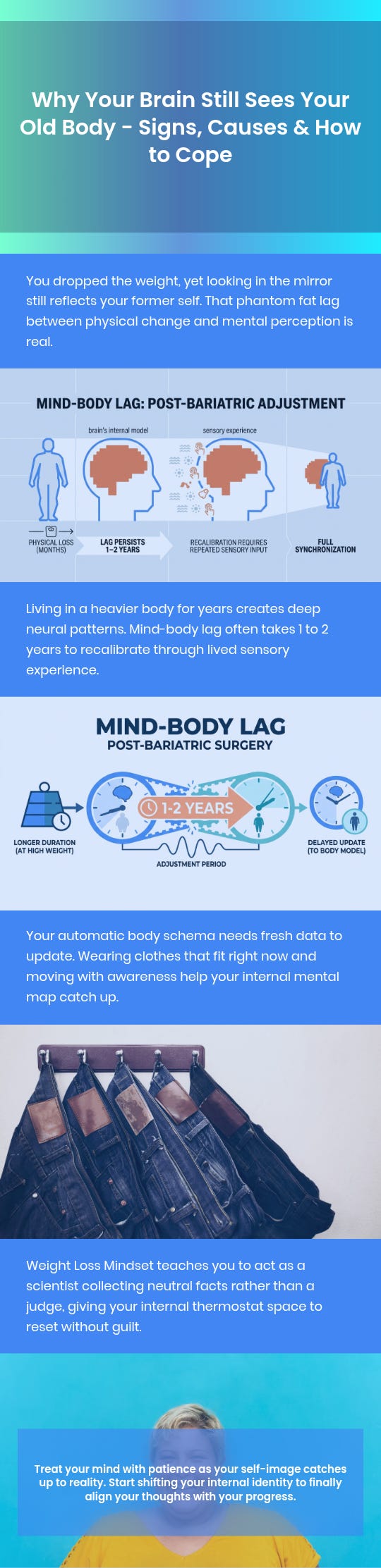
You’ve lost the weight, but why does your brain still flash images of your old body in the mirror? Researchers have a name for this unsettling lag, and knowing why it happens is the first step toward closing the gap.

Key Takeaways
A lingering gap between a changed body and how someone perceives it is common after rapid or substantial weight loss, and it has a name: the phantom fat phenomenon
Mirror checking, photo comparisons, and constant reassurance-seeking can keep body-image distress alive instead of resolving it
Body neutrality, which focuses on respecting what the body can do rather than loving how it looks, can be a more realistic starting point than forcing positivity
Certain warning signs mean the mismatch has moved beyond normal adjustment and deserves a closer look
Cognitive behavioral therapy offers specific tools for addressing distorted appearance beliefs and the habits that reinforce them
Losing a large amount of weight is supposed to feel like crossing a finish line. For many people over 40, though, the mirror tells one story while the mind keeps repeating another, older one. The body has changed, sometimes dramatically, yet the felt sense of size lags stubbornly behind.
Still Seeing an Old Body?
This experience has a name: the phantom fat phenomenon, sometimes called ghost fat. It describes the lag between a body that has visibly changed and a brain that has not yet updated its internal sense of that body’s size. The mismatch tends to show up most after weight loss that happens quickly or in large amounts, since the brain simply has less time to catch up with the new reality.
It helps to know upfront that this is not a personal failing or a sign of ingratitude for progress made. Resetting the mind after a major body change is a normal part of adjustment rather than evidence that something is wrong with the person experiencing it. This piece explains why the lag happens, what it tends to look like, and when it calls for more than patience. For more on building a steadier relationship with food and body image, Weight Loss Mindset covers these ideas regularly.
Most people will feel at least some version of this disconnect, and for most, it fades with time and repeated experience. The sections ahead walk through what that fading process can look like, along with the signs that suggest a person might benefit from extra support.
What Phantom Fat Looks Like
The phantom fat phenomenon does not look the same for everyone, but certain patterns show up again and again. Recognizing them is the first step toward knowing whether what someone is feeling fits the ordinary adjustment period or something that needs more attention.
Signs of a Lingering Mismatch
Several signs tend to cluster together when this mismatch is active. A person might notice one or several of the following:
Still picturing or “seeing” the former body size, even while looking directly at a changed reflection
Fixating on specific features such as loose skin, stretch marks, or a body part that does not match the mental image of what the “after” body was supposed to look like
Checking mirrors repeatedly, or the opposite: avoiding mirrors and photos altogether
Comparing the current body to other people’s bodies, especially images seen on social media
Seeking frequent reassurance about appearance, or brushing off compliments when they come
None of these signs alone necessarily points to a serious problem. They become more meaningful when they show up often, feel distressing, and start shaping daily decisions.
Normal Adjustment vs. a Red Flag
Some disconnect between the eyes and the mind is simply part of getting used to a new body. Being surprised by a reflection, needing a moment to recognize a face in a photo, or feeling unfamiliar in new clothing sizes all fall into the category of ordinary adjustment.
The picture shifts when the preoccupation becomes persistent, painful, and starts interfering with daily life. Spending long stretches of most days thinking about perceived flaws, avoiding social events or intimacy because of body shame, or feeling that distress is steering choices around food and exercise are signs that the experience has moved past typical adjustment. At that point, the mismatch is worth discussing with a professional rather than waiting it out.
Why the Brain Lags Behind
Understanding why this gap exists can take some of the sting out of it. The lag reflects how the brain tracks and updates its sense of the body over time, rather than stubbornness or imagination.
Body Image vs. Body Schema
Researchers draw a distinction between two related but separate systems. Body image refers to the conscious beliefs, feelings, and judgments a person holds about their own appearance. Body schema is different: it is the automatic, sensory-motor map the brain relies on to move through space, judge distances, and estimate size without conscious thought.
Body image can shift fairly quickly, sometimes in response to a single photo, a comment from someone else, or clothes that suddenly fit differently. Body schema updates far more slowly, through repeated movement, touch, and lived physical experience. When those two systems fall out of sync, a person can know, intellectually, that their body has changed while still feeling, physically and instinctively, like their old size. That gap sits at the heart of the phantom fat phenomenon.
Stigma, Comparison, and Past Experience
The brain does not update in a vacuum. Years of weight-related stigma, teasing, or unkind comments can create a fixed, negative self-image that resists updating even when the body itself has clearly changed. Social comparison adds another layer of pressure, particularly when idealized before-and-after photos online make a real, imperfect transformation feel like it falls short.
Other factors can deepen the mismatch as well. Perfectionism, anxiety, and depression can all make it harder for the mind to accept new, positive evidence about the body. For someone who spent decades at a higher weight, the movement patterns, spatial habits, and self-perceptions built up over that time may simply take longer to loosen their grip, regardless of how much the scale or the mirror has changed.
Checking Habits That Keep Distress Alive
It feels natural to want certainty about how one looks now, especially after years of body frustration. The trouble is that many of the habits people use to find that certainty end up reinforcing the very distress they are trying to resolve.
How Mirror Checking Backfires
Frequent mirror checking, repeated measuring, obsessive photo comparisons, and constant social-media scrolling can offer a brief sense of relief or control. That relief rarely lasts. Each check tends to feed the next one, training attention to zero in on perceived flaws rather than taking in the whole picture.
A more useful approach involves setting clear boundaries around these habits. Limiting how often appearance gets checked, curating social feeds to remove accounts that trigger comparison, and pausing before seeking reassurance from others can all help break the cycle. When a mirror check does happen, standing at a normal conversational distance and describing the body in neutral, specific language, rather than zooming in on one disliked area, tends to be more useful than prolonged, critical inspection.
Helping the Mind Catch Up
The brain updates its sense of the body gradually, through repeated, low-pressure contact with reality rather than through willpower or forced positivity. A few practical habits can support that process over time.
Practicing Body Neutrality
Trying to love one’s appearance overnight is rarely realistic, and chasing that goal can backfire by adding pressure on top of an already tender subject. Body neutrality provides a gentler aim: respecting the body for what it does rather than measuring it purely by how it looks.
This might mean acknowledging that the body carried someone through a demanding workday, allowed them to play with grandchildren, or recovered from an illness. Neutral self-talk fits naturally here too. A phrase like “my body has changed, and my mind is still adjusting” states the situation honestly without treating the mismatch as a personal failure.
Gentle, Repeated Evidence of Change
The mind tends to respond better to small, repeated proof than to one dramatic realization. Wearing clothes sized for the current body, rather than holding onto looser, “safe” clothing, gives clearer physical feedback than baggy garments that preserve the old mental image.
Occasional photos, taken without excessive scrutiny, can also help register change over time. Beyond appearance, paying attention to shifts in energy, mobility, sleep quality, and strength offers evidence of change that has nothing to do with the mirror. These non-appearance signals often carry more weight for the brain’s internal recalibration than appearance alone.
When to Seek Professional Support
Most people move through some version of this adjustment period and find that the mismatch softens with time. For others, the distress persists or grows, and that calls for a different response than patience alone.
Certain signs point clearly toward professional help: persistent hopelessness, avoidance of social situations, restrictive eating, compulsive exercise driven by body shame, or thoughts of self-harm or suicide. Any of these deserves prompt attention from a qualified mental health professional, and thoughts of self-harm call for immediate emergency or crisis support rather than a wait-and-see approach.
How Cognitive Behavioral Therapy Can Help
Cognitive behavioral therapy is a widely used approach for addressing distorted appearance beliefs and the rituals that often accompany them, including mirror checking, reassurance seeking, and comparison. Treatment can involve techniques such as exposure and response prevention, where a person gradually faces feared situations, like mirrors or social settings, while practicing resistance to the usual checking or avoidance behaviors.
Other elements sometimes used alongside this work include cognitive restructuring, which targets unhelpful thought patterns directly, and mirror retraining, which teaches more neutral, descriptive ways of looking at one’s own reflection. A therapist can tailor these tools to the specific patterns a person is experiencing, rather than applying a one-size-fits-all script.
The Body Changes Before the Mind Does
The timeline for physical transformation and mental adjustment rarely match up perfectly, and that gap deserves naming rather than hiding. A body can change in months while the brain’s internal map takes considerably longer to catch up, shaped by years of lived experience, old habits, and sometimes old wounds.
Patience paired with gentle, repeated evidence tends to serve this process better than pressure or forced positivity ever could. For those finding that the gap does not close on its own, a mental health professional familiar with body image and weight-related concerns can offer targeted support. For a deeper look at building a steadier, more peaceful relationship with food and body image over time, these weight loss mindset resources are worth a look as a next step.