Losing 30 pounds sounds simple until the scale stalls for weeks. One CDC-backed detail reveals why rushing the process often backfires, and why your weekly pace matters far more than any fixed deadline. Here’s the realistic timeline most guides skip.

Key Takeaways
Losing 30 pounds at a pace of 1 to 2 pounds per week typically takes about 4 to 7 months, though a slower pace of half a pound a week can stretch closer to 14 months and still count as real progress
A weight-loss plateau is a normal signal to review habits like sleep, stress, and portion sizes rather than a sign of failure
Calorie needs shift as the body changes size, so a plan built for a starting weight may need an update partway through
An identity-first approach treats slip-ups as information to learn from instead of reasons for guilt
Specific habits that help keep the scale moving in a steady direction are covered in detail below
Thirty pounds is a real number with a real finish line, but the calendar date for reaching it depends more on daily choices than on any app’s countdown clock. Anyone who has pushed through a short, restrictive challenge only to regain everything within a few months already knows that speed and permanence rarely travel together. This guide breaks down what a realistic timeline looks like, what actually moves the needle, and how to handle the stretches where nothing seems to budge.
How Long 30 Pounds Really Takes
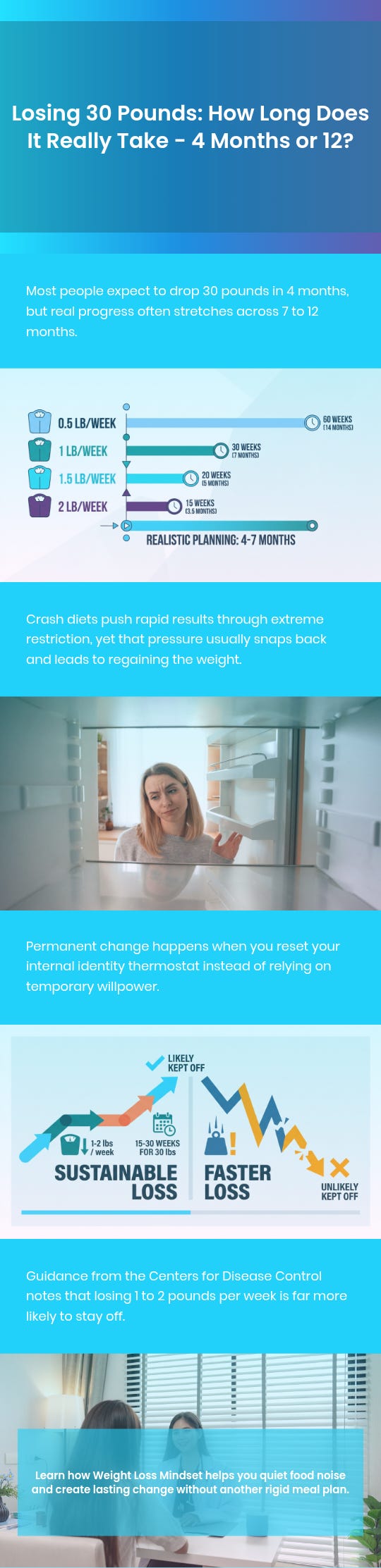
For most people, losing 30 pounds takes about 4 to 7 months at a pace of 1 to 2 pounds per week. That range lines up with guidance from the Centers for Disease Control and Prevention, which notes that people who lose weight gradually at roughly 1 to 2 pounds a week are more likely to keep it off compared to those who lose it quickly. A slower pace of around half a pound per week can push the timeline closer to 8 to 12 months, and that outcome deserves just as much credit as a faster one.
The honest answer is that nobody can hand over a guaranteed deadline, because the body doesn’t operate on a fixed schedule. Pace, pauses for travel or illness, and shifts in daily routine all stretch or compress the timeline in ways a simple calculator can’t predict. Weight Loss Mindset focuses less on the finish line and more on building an identity that naturally supports the habits needed to get there, which tends to matter more over months than any single week’s results.
Thinking in terms of a flexible window rather than a hard deadline also takes pressure off the process. A target of 5 to 8 pounds lost per month, with faster progress at the start and a slower pace later on, gives a workable frame without turning the scale into a daily referendum on self-worth.
Timelines by Weekly Pace
0.5 to 2 Pounds Per Week Compared
Laying out the math side by side makes the trade-offs easier to see:
Losing 0.5 pound per week adds up to about 60 weeks, or roughly 14 months, to reach 30 pounds. This pace is gentle and often the easiest to sustain alongside a full life.
Losing 1 pound per week takes about 30 weeks, or close to 7 months, often described as a steady, sustainable standard.
Losing 1.5 pounds per week lands around 20 weeks, or about 5 months, a common middle-ground pace.
Losing 2 pounds per week finishes in about 15 weeks, or roughly 3.5 months. This pace is usually more realistic early in the process or for someone starting at a higher body weight.
These numbers assume a straight line, but real life rarely moves that way. Plateaus, a few weeks of travel, a bout of illness, or a planned maintenance break can all add time beyond what the weekly-rate math suggests, which is why a planning window of several months tends to be more honest than a single target date.
Why Slower Can Still Win
A slower pace sounds less exciting, but it tends to protect the outcome that actually matters: keeping the weight off. NHS Inform guidance describes 1 to 2 pounds a week as a safe and achievable rate, built around small changes that can be sustained over the long term rather than rapid losses that are hard to maintain. Quick fixes often produce results that fade, while slower, steadier changes give new habits time to become second nature instead of a temporary performance.
There’s also a practical argument for going slower: a gentler calorie deficit is easier to live with day after day. Someone who rarely feels deprived is far less likely to abandon the plan altogether, which matters more over a year than shaving a few weeks off the timeline.
What Actually Changes Your Pace
Starting Weight, Consistency, and Activity
Starting weight plays a bigger role than many people expect. Those carrying more weight at the outset often see faster initial losses, partly because a higher starting weight creates a bigger calorie deficit at the same intake level. That early momentum tends to slow down as the body gets lighter, which is normal and not a sign that something has gone wrong.
Consistency, though, tends to outweigh almost every other factor. A moderate calorie deficit that someone can actually stick with for months will beat an aggressive one that gets abandoned after a couple of weeks, every time. Muscle and activity levels matter too, since preserving lean mass through movement helps keep the metabolism working in favor of continued progress rather than against it.
Sleep, Stress, and Early Water Weight
Sleep and stress quietly shape how hard or easy the whole process feels. Poor sleep and chronically high stress tend to increase hunger signals and make sticking to any plan more difficult, regardless of how well-designed the plan is on paper. Addressing these factors is part of the core work, not a side project to tackle later.
Early weigh-ins can also be misleading in a hopeful way. The first week or two of a new approach often shows faster drops on the scale due to water weight shifting, rather than fat loss specifically. Later losses tend to even out and slow down, which is expected rather than a signal that progress has stalled.
Habits That Support Steady Loss
Moderate Deficit and Protein at Meals
A deficit of roughly 500 to 750 calories a day below baseline is a common and reasonable starting point for losing around 1 to 2 pounds a week. Going far below that, especially down toward 1,200 calories a day, carries its own risks. Guidance on plateaus warns that cutting too low may not even prevent constant hunger and can raise the risk of overeating later, which undercuts the whole goal.
Including a protein source at each meal supports fullness and helps protect muscle while the body is in a calorie deficit. This is a small, repeatable habit rather than a dramatic overhaul, and it fits naturally into regular meals without requiring a complete diet rebuild.
Strength Training and Daily Movement
Strength training at least twice a week helps preserve muscle, which in turn supports a healthier body composition as the scale moves down. Pairing that with regular, low-effort movement, like daily walking, rounds out an approach that doesn’t depend entirely on intense workouts to work.
Resistance training two or more times weekly protects lean muscle during fat loss.
Regular walking or similar daily movement adds up over time without requiring a gym membership or special equipment.
Specific activity goals, such as a short walk before work on set days, tend to stick better than a vague promise to move more.
Tracking Trends Over Daily Scale Swings
A single morning weigh-in can swing several pounds based on sodium, hydration, or hormones, which makes it a poor judge of real progress on its own. Looking at a weekly average weight, along with measurements, photos, or how clothes fit, gives a far steadier picture of what’s actually happening over time.
This shift in focus, from daily numbers to weekly or monthly trends, also protects motivation. A single disappointing weigh-in feels much less significant when it’s viewed as one data point among many rather than a verdict on the whole effort.
When Progress Stalls
Reading a Plateau as a Cue, Not a Failure
A plateau is simply a stretch where weight stops changing, often because the same habits that produced earlier loss are now just maintaining the current weight rather than lowering it further. Guidance from Mayo Clinic describes this as a normal part of the process, not a sign that the effort has failed or that the plan needs to be scrapped entirely.
Treating a stall as useful information rather than a personal failing changes how someone responds to it. Reviewing food and activity records during a plateau can reveal small shifts, like larger portions creeping in, more processed food replacing home-cooked meals, or less daily movement than before, that explain why the scale has stopped moving.
Reassessing Calorie Needs as Weight Drops
A body that weighs 190 pounds needs fewer calories to maintain itself than the same body did at 220 pounds, which means a calorie target set at the start of a weight-loss effort will eventually need updating. Skipping this recalculation is one of the quieter reasons a plan that worked well for months suddenly seems to stop working.
This isn’t a reason to cut calories aggressively out of frustration. A modest adjustment, paired with a fresh look at activity levels, protein intake, and sleep, usually does more good than a sudden drop in intake that risks the same hunger and overeating cycle mentioned earlier.
When to Loop In a Healthcare Professional
Certain situations call for professional input rather than guesswork. Anyone managing a medical condition, taking medication that affects weight, pregnant, or working through a history of disordered eating benefits from setting a pace and calorie target in consultation with a healthcare professional rather than relying on general guidelines alone.
This isn’t a sign that the identity-based or habit-based approach has failed. It simply means some circumstances need an extra layer of personalized guidance, and getting that input early tends to prevent bigger setbacks later.
The Timeline Depends on the Pace You Sustain
Thirty pounds will come off on a schedule shaped by consistency, not by a number chosen in advance. A pace of 1 to 2 pounds a week over 4 to 7 months fits most people well, but a slower pace that respects sleep, stress, and real life is still a legitimate path to the same destination.
The habits that matter most, a moderate calorie deficit, protein at meals, regular strength training and movement, and tracking trends instead of daily swings, work steadily in the background no matter which week of the process someone is on. Plateaus and pauses are part of the process rather than proof that something has gone wrong. For a steady, sustainable approach to the next 30 pounds, these weight loss mindset tools focus on building habits made to last well beyond the final pound.