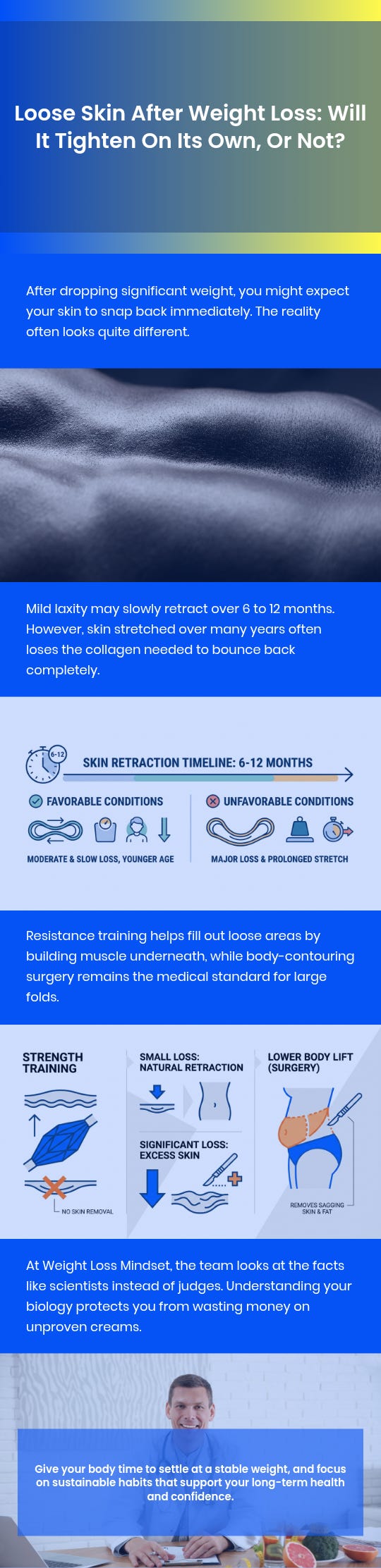
After major weight loss, will your skin ever tighten back up? There’s a specific window, roughly 6 to 12 months, where most natural improvement happens, and what you do during it could determine whether surgery becomes necessary.

Key Takeaways
Skin often keeps settling for about 6 to 12 months after weight loss, with younger age, slower weight loss, and good baseline elasticity linked to better retraction
Skin that has been stretched for a long time or lost very quickly may never fully tighten back to its original shape, no matter how healthy the habits afterward
Strength training builds muscle beneath loose skin and can improve shape, but it cannot physically remove excess skin
Radiofrequency, microneedling, and ultrasound treatments may modestly firm mild skin laxity, though results tend to be less dramatic than surgical options
Body-contouring surgery remains the most reliable fix for significant excess skin, but timing around weight stability matters a great deal - more on why that waiting period exists below
Losing a large amount of weight changes more than the number on the scale. For many people over 40, it also leaves behind loose or sagging skin that did not shrink back the way the rest of the body did. Understanding what skin can realistically do after weight loss, and matching treatment to the actual problem, separates wasted effort from real progress.
Will Your Loose Skin Tighten Up?
Loose skin after substantial or rapid weight loss is common, and it shows up differently from person to person. Some people notice only mild slackness that smooths out with time. Others are left with heavier folds of skin that do not budge no matter what they try. The outcome depends on how much weight came off, how fast it happened, and the condition of the skin before weight loss even began.
Skin behavior varies enough that no single promise fits everyone. Mild laxity sometimes responds to patience and simple at-home care, while significant excess skin typically needs a different kind of solution. The physical healing timeline deserves the same patience as the mental work involved in reaching a lower weight in the first place. Weight Loss Mindset focuses primarily on identity and behavior change, and that same patience applies to how the body finishes its own process.
Knowing what is realistic from the start helps avoid frustration later. The next stretch of time after weight loss, often called the retraction window, is where most of the natural improvement happens.
The 6-12 Month Retraction Window
Skin does not snap back instantly once weight comes off. Instead, it continues adjusting gradually, often over a period of about 6 to 12 months. This window tends to apply best to people who lost a moderate amount of weight rather than an extreme amount, and the pace of that loss matters just as much as the total.
Factors That Favor Better Retraction
Certain conditions give skin a better shot at tightening on its own. These include:
Younger age, since skin naturally holds more elastic fibers earlier in life
Slower, more gradual weight loss rather than rapid drops
Better baseline skin elasticity before weight loss began
A smaller total amount of weight lost, since moderate loss places less demand on the skin’s ability to shrink
These factors do not guarantee a particular result, but they tilt the odds toward a smoother recovery during that 6 to 12 month stretch.
When Skin Won’t Fully Bounce Back
Skin that has been stretched for a long stretch of time, or stretched dramatically by major weight loss, often does not return to its earlier tightness. Age plays a role here too, since skin loses collagen and elastin over the years regardless of weight. Smoking history also affects elasticity and healing, according to guidance from Homerton Healthcare NHS Foundation Trust’s bariatric service. For some people, the retraction window closes with meaningful improvement still visible; for others, the folds that remain at month twelve are largely the folds that will stay.
Nonsurgical Options for Mild Laxity
For people dealing with mild sagging rather than significant folds, several nonsurgical approaches can help smooth things out, even if they cannot erase loose skin completely.
Strength Training and Stable Weight
Building muscle underneath loose skin is one of the most useful tools available without a scalpel. Resistance training adds shape and firmness beneath the skin, which can make the overall area look more toned even though the skin itself has not changed. The skin stays the same, but how it sits on the body changes.
Keeping weight steady matters just as much as the exercise itself. A stable weight gives skin time to settle into its new shape and can protect the results of any future surgery, though stability alone does not guarantee full retraction. In the meantime, compression garments and well-fitting clothing can ease discomfort and make loose skin less noticeable day to day.
Creams, Retinoids, and Collagen Claims
Skin creams marketed for tightening come in many forms, and their results vary widely. Creams containing hyaluronic acid or natural oils can improve surface hydration and texture, which may make skin feel and look healthier, though they do not remove or meaningfully tighten loose skin. Retinoid or retinol-based creams may offer a modest improvement in skin quality for mild laxity, according to a WebMD explainer on the topic, though they are not a treatment for significant excess skin.
Collagen-based creams deserve a closer look, since they are heavily advertised. The same WebMD source notes that collagen creams do not appear to meaningfully support the skin’s own collagen production, so the marketing promise often outpaces what the product can actually deliver. Nutrition and hydration support general skin and tissue health as well, but the evidence that diet alone dramatically tightens loose skin remains limited.
Radiofrequency, Microneedling, and Ultrasound
Device-based treatments sit in a middle ground between creams and surgery. Radiofrequency, microneedling, and ultrasound treatments work by stimulating collagen remodeling beneath the skin’s surface, and they may modestly firm mild laxity. A systematic review published in Aesthetic Plastic Surgery looked at 41 studies on radiofrequency microneedling, and of the 13 that assessed skin laxity and wrinkles, all reported some improvement. The same review cautioned that results vary substantially depending on the condition being treated, and that long-term comparative data remain limited, describing the findings as promising but not sufficient to call radiofrequency microneedling a universal fix. These treatments offer a modest improvement, not a replacement for surgical skin removal when excess skin is significant.
For people specifically carrying excess skin after major bariatric weight loss, Cleveland Clinic notes that treatments like CoolSculpting target fat rather than loose skin, and are generally not suited to this population at all.
When Loose Skin Becomes a Medical Problem
Loose skin is a cosmetic concern for some people, but it also carries physical implications. When folds of excess skin become heavy or persistent enough, they can create real physical problems that go beyond appearance.
Chafing, Infections, and Limited Mobility
Folds of skin, especially around the abdomen, thighs, or underarms, can trap moisture and create friction with movement. This combination often leads to chafing, rashes, and recurring skin infections that do not resolve with typical skincare. A clinical review in Aesthetic Surgery Journal describes how excess abdominal or thigh folds after major weight loss can contribute to skin breakdown, infections, and hygiene difficulties, along with trouble walking in more severe cases.
Several National Health Service commissioning bodies in the United Kingdom treat these functional problems as a distinct medical category, separate from cosmetic preference. Birmingham and Solihull ICB’s policy, for example, considers funding for skin removal when folds impair everyday activities or when recurrent infections have not improved after six months of other treatment. Herefordshire and Worcestershire’s clinical guidance similarly calls for an assessment of functional problems by an appropriate professional before surgery is considered. When skin folds start interfering with daily life rather than just self-image, that shift often marks the point where medical evaluation becomes worthwhile.
Body-Contouring Surgery: Timing and Risks
For significant excess skin, body-contouring surgery is generally recognized as the most thoroughly studied and reliable solution. Procedures like abdominoplasty remove excess skin and fat from the abdomen and can ease the functional difficulties that heavy skin folds create, according to NHS Herefordshire and Worcestershire clinical guidance.
Why Doctors Wait for Weight Stability
Surgeons do not typically operate the moment someone reaches a lower weight. A review published in Plastic and Reconstructive Surgery - Global Open notes that post-bariatric body contouring is generally delayed until weight loss is complete and stable for at least six months, which commonly lands at least 12 months after bariatric surgery itself. Cleveland Clinic echoes this timeline, noting that reaching a goal weight after bariatric surgery can take one to two years, and that body contouring should wait until that weight loss has been maintained for at least six months.
Some protocols are even more specific about what stability means in practice. A clinical review in Aesthetic Surgery Journal describes a practice requirement of weight staying within 10 pounds for at least six months, and at least one year after bariatric surgery, before contouring surgery proceeds. NHS South Tees Hospitals applies a similar standard, excluding referrals where weight loss has not been sustained for more than six months. The reasoning is straightforward: operating before weight settles risks removing skin that the body might still shed on its own, or leaving behind skin that stretches again if weight continues to shift.
Known Complication Rates
Body-contouring surgery carries real risks worth understanding before moving forward. The Plastic and Reconstructive Surgery - Global Open review reports an overall complication rate around 13% across body-contouring procedures, with wound separation and seroma among the most common issues. Aesthetic Surgery Journal lists a broader range of possible complications, including scarring, asymmetry, hematoma, infection, and deep venous thromboembolism.
These risks do not mean surgery should be avoided, but they do underscore why timing and surgeon selection matter. A patient whose weight has genuinely stabilized, who understands the recovery process, and who works with an experienced surgical team is in a very different position than someone rushing into surgery immediately after reaching a goal weight.
Surgery Remains the Most Reliable Fix for Significant Excess Skin
For mild sagging, patience combined with strength training, stable weight, and modest skincare routines can genuinely help. For significant excess skin, particularly when it causes chafing, infections, or limits on daily movement, body-contouring surgery stands out as the option with the strongest track record. The folds themselves rarely resolve through diet and exercise alone, a point echoed by Homerton Healthcare NHS Foundation Trust’s guidance on excess skin following significant weight loss.
The path forward depends on an honest look at how much skin is involved, whether it is causing physical symptoms, and whether weight has truly settled. For anyone sorting through that decision, understanding loose skin recovery after weight loss as part of the full picture, alongside the mental work of keeping weight off for good, can make the next step clearer.