

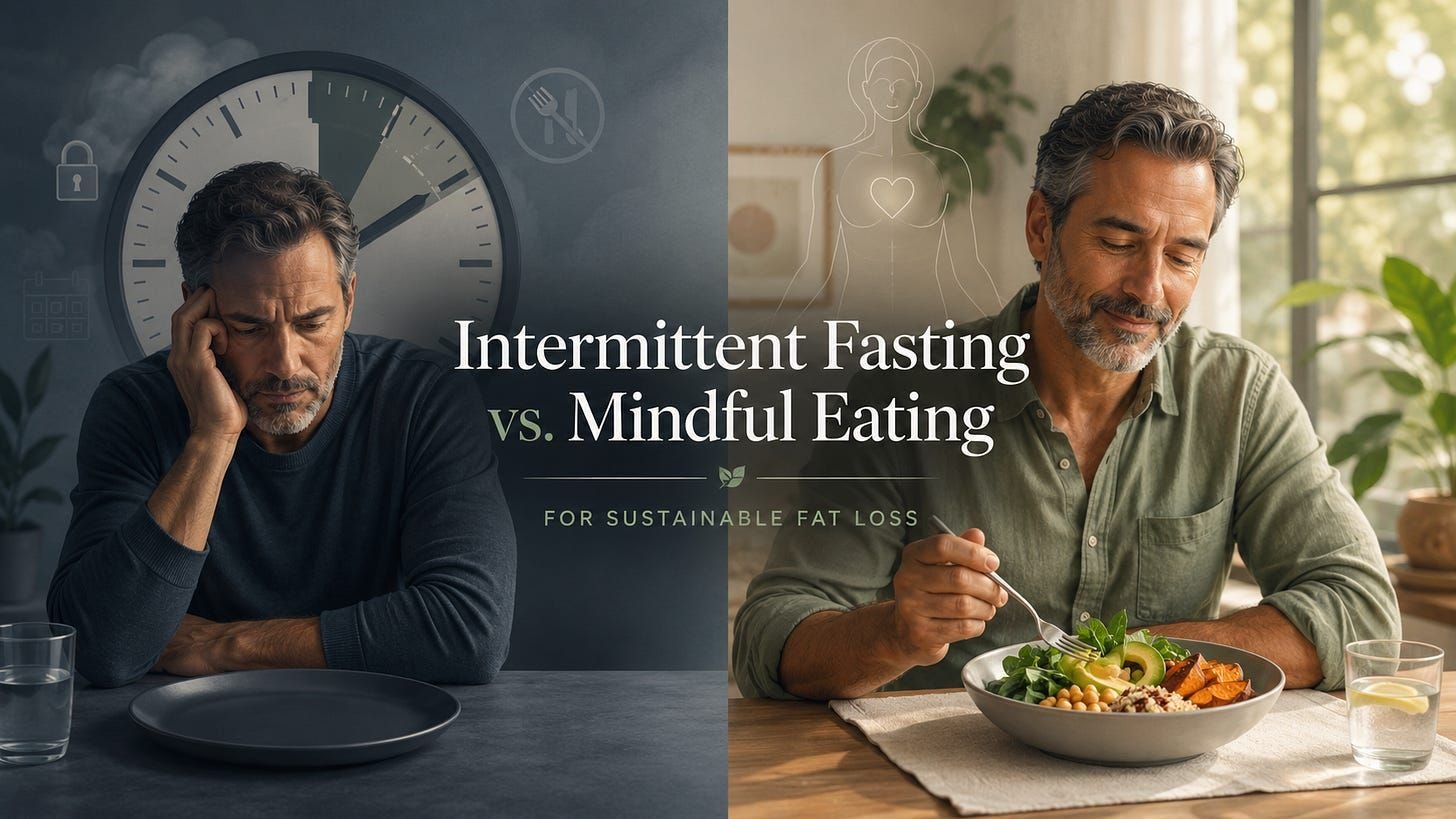
At a glance:
IF works because it reduces total calorie intake. The clock is just a container.
In clinical trials, 38% of IF participants dropped out, higher than the rate for standard caloric restriction.
Your body reads a fasting window as a starvation signal, flooding you with cortisol and ghrelin that can override every intention.
Mindful eating rebuilds the interoceptive awareness that years of dieting have damaged: your ability to actually feel hunger and fullness.
Neuroimaging shows mindful eating physically quiets the brain’s food reward pathway, the architecture of food freedom.
IF manages the clock. Mindful eating changes the relationship. One of these is a life. The other is a calendar.
The question itself is a trap
Every few months, the diet world picks a champion.
Right now it’s intermittent fasting. Before that it was keto, then low-fat, then high-protein, then paleo, then six meals a day. The names change. The promise stays identical: follow the protocol, lose the weight, get your life back.
The people who’ve made this exact bet a dozen times know something the wellness industry won’t say out loud: the problem runs deeper than any protocol. The relationship with food is the thing that needs to change.
This article isn’t interested in crowning a trend. Both deserve a real look. Both produce results, though for different reasons, with different durability, and at different costs to the person living inside them.
By the end, we’re not landing on a meal schedule. We’re landing on something more useful: clarity about what actually drives sustainable fat loss, and why the tool you choose matters far less than the transformation underneath it.
What intermittent fasting actually does
Let’s start with the research, not the Instagram version.
Intermittent fasting, in its most common forms, means compressing your eating into a specific window each day (16:8 being the most popular: 16 hours fasted, 8 hours eating) or dramatically cutting calories on certain days of the week (the 5:2 protocol). Alternate day fasting goes further still.
The results are real. A 2025 BMJ meta-analysis covering dozens of randomized clinical trials confirmed that intermittent fasting reduces body weight compared to unrestricted eating. Studies show modest but consistent improvements in insulin sensitivity, triglyceride levels, and blood glucose markers. For people with type 2 diabetes or metabolic syndrome, some IF protocols offer meaningful clinical benefit.
So far, so compelling.
The same research buries something important: intermittent fasting produces weight loss primarily because it reduces total calorie intake. The mechanism has nothing to do with the timing itself. As one expert commenting on the BMJ review put it, “there’s nothing magical about intermittent fasting for weight loss beyond being another way for people to keep their total calorie intake lower.” The window creates constraint, the constraint reduces intake, and the reduced intake produces weight loss.
That mechanism works. Whether it keeps working is a different question.
The clock and the chemistry it starts
When your body enters a fasting window, it doesn’t know you’ve made a lifestyle choice. It knows one thing: the food stopped coming.
The body’s response to that signal is ancient and automatic. Cortisol, your primary stress hormone, rises. Research consistently shows intermittent fasting elevates cortisol, sometimes significantly, particularly in women. Ghrelin, the hunger-signaling hormone, surges. In some studies, fasting-induced cortisol disrupted the normal coupling between cortisol and other hormones including growth hormone, leptin, and luteinizing hormone: a cascade of hormonal discoordination that extends well beyond the eating window.
This matters for people over 40, because cortisol is already under pressure from aging, stress, poor sleep, and a decade (or three) of diet cycling. Adding another stress signal on top of an already burdened system can deepen the underlying chaos.
There’s also the rebound phenomenon. When the eating window opens, especially on an empty stomach flooded with ghrelin, the body isn’t waiting patiently for a measured meal. It’s primed to consume. Clinical research has documented what the diet industry rarely mentions: fasting followed by eating can trigger loss-of-control eating, particularly in people with any history of emotional eating or dietary restraint. Research published in Appetite found that fasting was associated with increased food cravings and, in some individuals, binge-eating behavior.
The body is running exactly the survival software it was designed to run. Evelyn Tribole, registered dietitian and co-author of Intuitive Eating, puts it plainly: “Once you venture into primal hunger, a survival mechanism kicks in.” Willpower doesn’t evaporate in those moments. It gets biologically overridden. The difference matters.
The dropout problem nobody talks about
Keeping food out of reach during a fasting window is like holding a beach ball underwater. You can do it. For a while. The longer you hold, the more strength it costs, and the harder the surface breaks when your arms finally give out.
If intermittent fasting worked the way it’s described in promotional material, adherence wouldn’t be an issue.
It is.
Research from Trepanowski and colleagues found dropout rates were highest in the intermittent fasting group (38%), compared to 29% for standard caloric restriction and 26% for the no-intervention control group. A Nordic Nutrition Report found that while IF showed good initial adherence, that adherence declined measurably over time. Another study tracking time-restricted eating found real-world adherence closer to 63% after just 5 weeks, even among motivated participants.
Thirty-eight percent of people in clinical trials, where there is accountability, monitoring, and behavioral support, couldn’t maintain the protocol. The number falls much further in real life, where dinner parties exist, work trips happen, families don’t observe your eating window, and emotional life refuses to schedule itself around your app.
A protocol that forces you to white-knuckle through hunger until a clock releases you puts you in a permanent negotiation with your own biology. That negotiation is exhausting. And exhausted people stop negotiating.
What mindful eating is, and what it isn’t
Mindful eating is a practice.
It has no meal plan, no macro targets, no eating window, no forbidden foods. It doesn’t tell you when to eat, what to eat, or how much. Which, if you’ve spent years living inside rule-based systems that promised control and delivered frustration, probably sounds either refreshing or terrifying, depending on how long you’ve been at this.
At its core, mindful eating means being present during eating. You pay attention to hunger before you begin, slow down enough to catch satiety as it arrives, notice whether what you’re feeling is physical or emotional, and choose deliberately instead of on autopilot.
That description sounds simple. The practice isn’t. Because most people who struggle with food have lost access to the internal signals mindful eating depends on. Years of dieting, restricting, compensating, then restricting again, dull the very skill the practice requires: the ability to accurately read your own hunger and fullness. The compass gets scrambled.
Mindful eating’s core project is recalibrating that compass.
A literature review of 68 intervention and observational studies found these strategies improved eating behaviors in concrete ways: slowing the pace of meals, recognizing fullness more accurately, establishing greater control over eating choices. A 2024 review confirmed that mindful eating produces “sustainable, long-term changes in eating behaviors and overall well-being.” That word “sustainable” is doing a lot of work in that sentence.
What the brain says about mindful eating
The strongest case for mindful eating is neurological, especially for anyone who’s ever felt pulled toward food by something that seemed beyond any choice they could make.
That feeling was neurobiology.
The brain’s midbrain reward pathway is the circuit that drives motivation toward high-calorie food. Catch the smell of fresh bread, scroll past a food photograph, feel the particular edge of stress at 3pm: the circuit fires. It releases dopamine. It creates urgency. For many people, especially those with a history of emotional eating, this pathway is hypersensitive. The trigger doesn’t have to be hunger. Stress, boredom, loneliness, a passing thought: all of them pull the same lever.
Diets address this by adding rules. Rules that sit on top of a hypersensitive reward system and ask willpower to do the job neurobiology already owns.
Mindful eating addresses the wiring.
Neuroimaging research shows mindful eating physically dampens activity in the brain’s reward pathway and strengthens the prefrontal circuits where deliberate choices actually happen. An eight-week program tracked by fMRI showed the brain’s anticipatory response to high-calorie food had measurably quieted. A 2026 review in Frontiers in Nutrition described how mindful eating “decouples conditioned food cues from compulsive eating” at the level of neural architecture. A 2014 systematic review in Obesity Reviews found mindfulness-based interventions significantly reduced binge eating and emotional eating, with effects that held at follow-up.
The food noise gets quieter. The brain has genuinely changed its response to the signal. That’s the difference between managing a craving and losing interest in one.
The interoception factor: hearing your body again
There’s a specific skill mindful eating rebuilds, and it’s the one most chronic dieters have most thoroughly lost: interoception.
Interoception is your brain’s ability to accurately perceive the internal state of your body, including hunger, satiety, fullness, and the difference between physical and emotional appetite. Research from multiple independent teams shows that reduced interoceptive awareness correlates strongly with higher BMI, greater binge eating frequency, and greater susceptibility to emotional eating. People who can’t clearly hear the signal eat past it. Sometimes far past it.
Every fast you white-knuckle through trains you a little further away from listening to your own body. Outsourcing the decision to a clock teaches the brain that the clock is the authority. Over time, the body’s internal cues get quieter. We’ve been overriding them long enough that we’ve forgotten how to hear them.
Mindful eating reverses this. Studies show mindfulness training improves the ability to perceive bodily hunger signals. One study found that even a brief body-scan exercise measurably sharpened awareness of physical hunger cues. Research on intuitive eating, a closely related approach built on the same principles of internal attunement, found that people who ate intuitively showed better self-regulation, healthier weight maintenance, and significantly lower rates of binge eating than those relying on external rules and schedules.
When satiety becomes something you can actually feel, the mental negotiation around food starts to quiet. That quiet is the destination.
Where intermittent fasting earns its place
Fairness demands this section.
Intermittent fasting is a legitimate tool for specific people in specific contexts. The metabolic data is real: certain IF protocols improve insulin sensitivity, help regulate blood glucose, reduce triglycerides, and may support cellular repair processes. For people with type 2 diabetes or significant insulin resistance, some IF approaches offer meaningful clinical benefit that extends beyond caloric reduction alone.
For people who genuinely prefer structure, who find that a clear eating window removes decision fatigue without creating stress, and who don’t carry a history of disordered eating, IF can work sustainably. Some people thrive under time-based eating. Their hunger patterns fit the window. Their lifestyle accommodates it. Their relationship with food is stable enough that restriction doesn’t become a trap.
These people exist. They’re real. And for them, the tool fits.
Worth knowing, even for those people: IF works in part because it gives their relationship with food a container. The structure does some of what awareness would do. It’s a workaround. Workarounds that produce sustainable results matter. But understanding the mechanism keeps expectations honest.
The verdict for sustainable fat loss
For short-to-medium-term weight loss: IF and traditional caloric restriction land in the same place. The results are driven by a scheduling advantage that helps some people eat less without counting, and the metabolic mechanism is identical.
On metabolic markers, the picture brightens for IF. Genuine improvements in insulin sensitivity and triglyceride levels, particularly in people with metabolic disease. These benefits are real and clinically meaningful.
For long-term sustainability, mindful eating’s story is different. It addresses the psychological and neurological roots of disordered eating, reduces emotional eating and binge eating, and produces changes that hold at follow-up. Research on weight maintenance (the step that every diet approach eventually fails) shows mindful eating predicts long-term maintenance better than rule-based restriction approaches.
For the specific person over 40, exhausted from years of diet cycling, in a fractured relationship with food, and carrying the emotional weight of repeated failure: IF places new demands on a system that’s already strained. Mindful eating works at the source.
The difference comes down to what problem you’re actually solving.
If the problem is reducing calorie intake and you have the lifestyle and psychology to support a time window, IF is a reasonable tool.
If the problem is that you’ve been fighting your body for decades, you eat emotionally, you don’t trust your hunger signals, and the mental noise around food is costing you your quality of life, only a changed relationship with food reaches it.
The question underneath the question
Every conversation about fat loss eventually arrives here, whether people know it or not.
A fasting window can change when you eat. Counting macros can change what you eat. But beneath all of it runs a thermostat calibrated to your weight, your identity, and the whole shape of your relationship with food. You can override it for a while. Thermostats always win.
Mindful eating works at the level everything else reaches around.
The real question is: what kind of person do you want to be in relationship with food?
Do you want to be someone who manages food, who keeps a clock, tracks a window, follows rules that sit on top of a craving still running underneath?
Or do you want to be someone for whom food is simply food? Fuel, pleasure, connection. And the background noise that used to chase you through every meal has finally gone quiet.
The data makes its case for mindful eating. The more important argument lives past the data.
Freedom with food.
That’s the life worth having.
Research References: Intermittent Fasting vs. Mindful Eating
Listed in order of appearance in the article.
Intermittent fasting — efficacy and weight loss
1. BMJ 2025 systematic review and meta-analysis (primary IF evidence) “Intermittent fasting strategies and their effects on body weight and other cardiometabolic risk factors: systematic review and network meta-analysis of randomised clinical trials” Semnani-Azad Z et al., BMJ, June 2025 https://pmc.ncbi.nlm.nih.gov/articles/PMC12175170/
2. Expert commentary on the BMJ review (source of “nothing magical” quote) “Expert reaction to study comparing evidence on intermittent fasting and traditional calorie reduction diets for weight loss” Science Media Centre, June 2025 https://www.sciencemediacentre.org/expert-reaction-to-study-comparing-evidence-on-intermittent-fasting-and-traditional-calorie-reduction-diets-for-weight-loss/
IF and hormones — cortisol and ghrelin
3. IF and cortisol/hormonal disruption “Intermittent Fasting and Hormonal Regulation: Pathways to Improved Metabolic Health” Shkorfu W et al., Food Science & Nutrition, August 2025 https://onlinelibrary.wiley.com/doi/10.1002/fsn3.70586
4. IF, cortisol, and circadian rhythm disruption (source used for hormonal coupling claim) “Effects of intermittent fasting on the circulating levels and circadian rhythms of hormones” (Kim et al., 2021) — cited via: https://discovery.researcher.life/questions/does-intermittent-fasting-affect-the-production-of-cortisol-in-the-body/7cec6c28c301de12724724a6f1322ac6eed14f9d
IF and binge eating / rebound
5. Fasting, food cravings, and binge eating (Appetite journal) “Try not to think about food: An association between fasting, binge eating and food cravings” ScienceDirect, 2024 https://www.sciencedirect.com/science/article/abs/pii/S0027968424002098
6. Evelyn Tribole quote and psychological risks of IF “Intermittent Fasting: A Popular Diet With Serious Psychological Risks” Inverse https://www.inverse.com/article/58082-intermittent-fasting-psychological-risks-binge-eating
IF dropout and adherence
7. Trepanowski et al. dropout data (38% IF vs 29% CR) Referenced in: “Intermittent Fasting and Adherence” (UCL/Cook et al.) https://discovery.ucl.ac.uk/id/eprint/10158406/2/Serpell_cook%20et%20al%20IF%20paper%20submitted%20version.pdf
8. Nordic Nutrition Report on IF adherence declining over time “Meal patterns, including intermittent fasting” Food & Nutrition Research, 2024 https://foodandnutritionresearch.net/index.php/fnr/article/download/10505/16874/
9. Time-restricted eating real-world adherence (~63% after 5 weeks) “Exploring Rates of Adherence and Barriers to Time-Restricted Feeding” https://pdfs.semanticscholar.org/17be/9d938ca58bdab7db51a69bd8d17b29a3ae67.pdf
Mindful eating — general evidence and behavior change
10. 68-study literature review on mindful eating (Harvard Nutrition Source) “Mindful Eating” The Nutrition Source, Harvard T.H. Chan School of Public Health https://nutritionsource.hsph.harvard.edu/mindful-eating/
11. 2024 review confirming sustainable long-term changes (source of “sustainable” quote) “Examining the Efficacy of Mindfulness-Based Interventions in Treating Obesity, Obesity-Related Eating Disorders, and Diabetes Mellitus” Taylor & Francis, November 2024 https://www.tandfonline.com/doi/full/10.1080/27697061.2024.2428290
Mindful eating and the brain — neuroimaging
12. 8-week fMRI mindful eating intervention (striatum and midbrain) “The effects of an 8-week mindful eating intervention on anticipatory reward responses in striatum and midbrain” Janssen LK et al., Frontiers in Nutrition, August 2023 https://www.frontiersin.org/journals/nutrition/articles/10.3389/fnut.2023.1115727/full
13. 2026 Frontiers in Nutrition review (source of “decouples conditioned food cues” quote) “Mindful eating as the next therapeutic frontier in nutritional psychiatry” Frontiers in Nutrition, January 2026 https://www.frontiersin.org/journals/nutrition/articles/10.3389/fnut.2026.1726847/full
14. 2014 Obesity Reviews systematic review (binge eating and emotional eating, effects held at follow-up) “Mindfulness meditation as an intervention for binge eating, emotional eating, and weight loss: a systematic review” PubMed, 2014 https://pubmed.ncbi.nlm.nih.gov/24854804/
Interoception and hunger/satiety awareness
15. Body-scan mindfulness and physical hunger cues “The effect of a brief mindfulness intervention on perception of bodily signals of satiation and hunger” ScienceDirect, 2021 https://www.sciencedirect.com/science/article/pii/S0195666321001872
16. Interoceptive awareness, BMI, and eating behavior “Interoception, eating behaviour and body weight” ScienceDirect, 2021 https://www.sciencedirect.com/science/article/abs/pii/S0031938421001268
17. Intuitive eating, interoception, self-regulation, and weight maintenance “The Mediating Effect of Eating Behaviors on Interoception, Self-Regulation and Weight Status Among College Students” Nutrients, November 2024 https://www.mdpi.com/2072-6643/16/23/3986
Note: The Trepanowski et al. 2018 paper (reference 7) was accessed via a secondary source. The primary citation is: Trepanowski JF et al., “Effect of Alternate-Day Fasting on Weight Loss, Weight Maintenance, and Cardioprotection Among Metabolically Healthy Obese Adults,” JAMA Internal Medicine, 2017.