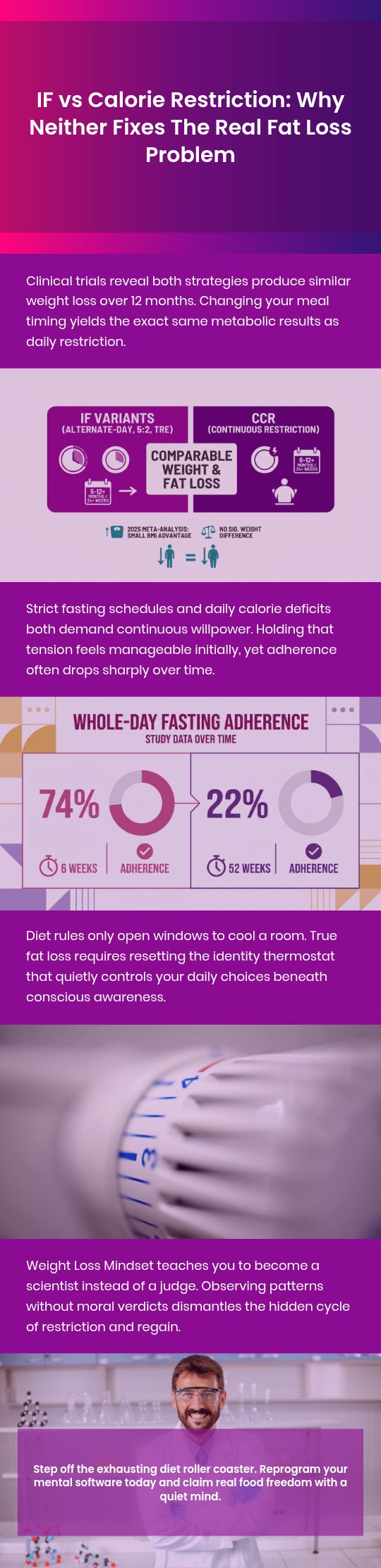
You’ve tried fasting windows and calorie apps, but after 12 months the scale tells a surprising story: one specific fasting style beats restriction by just 1.29 kg, while everything else ties. So what actually determines long-term weight maintenance?

Key Takeaways
Over 12 months or longer, intermittent fasting and daily calorie restriction tend to produce similar weight loss and similar rates of weight regain
Alternate-day fasting is the one pattern with evidence of a modest edge over continuous restriction, with a mean difference of about 1.29 kg more loss in one review, but that does not make fasting the better long-term method overall
Restrictive rules of any kind, including fasting windows and calorie counting, can trigger a rebound pattern some coaches call the Slingshot effect, where the harder the pull back, the harder the snap forward
People with diabetes medications, kidney or liver conditions, or a history of disordered eating should talk with a clinician before trying any fasting protocol
This piece explains how to tell whether a rule-based diet is likely to fail and what an identity-based alternative looks like
Anyone who has cycled through keto, calorie apps, and a strict eating window already knows the real question is not which diet is more clever. The real question is which one a person can actually live with for years, not weeks.
Neither Method Wins Long Term
For years, intermittent fasting has been marketed as the smarter, more modern path to fat loss, something that works with the body’s rhythms instead of grinding against them. The evidence tells a less dramatic story. When researchers track people for 12 months or longer, intermittent fasting and daily calorie restriction generally land in the same place: similar weight loss, similar changes to cardiometabolic risk factors, and similar odds of regaining the weight afterward.
That does not mean either method is useless. The method is rarely the deciding factor. What matters more is whether the day-to-day structure of the diet fits a person’s life, appetite, schedule, and relationship with food well enough to stick for the long haul. People over 40 who already know the mechanics of fasting and counting calories are often the ones most tired of plans that never hold.
That search for a lasting answer is exactly where this comparison needs to start: not with which diet burns more fat in a lab, but with what happens to real people after the excitement of a new plan wears off.
What Long-Term Evidence Actually Shows
Short-term results get most of the attention, but short-term results are not the same thing as a long-term solution. A diet that produces a fast drop on the scale in the first few weeks can still fall apart by month six, and that gap between early promise and lasting change is where most diet history actually lives.
Similar Results Over 12 Months
In a well-known 12-month comparison, people following time-restricted eating lost about 5% of their body weight, and people following daily calorie restriction lost about the same amount. Both groups maintained their loss over the course of the study, whether they were watching an eight- to ten-hour eating window or tracking a daily calorie target.
Comparisons of intermittent fasting against continuous low-calorie diets have not consistently found one approach beating the other, and one head-to-head year-long trial found no meaningful difference in weight loss, weight regain, or body composition between the two groups.
The One Exception: Alternate-Day Fasting
Alternate-day fasting stands out as the single pattern where a review found a measurable advantage over continuous calorie restriction, with a mean difference of about 1.29 kg more loss. That is a real finding, but it applies to one specific and fairly demanding fasting style, not to intermittent fasting as a category.
A 4:3 fasting plan has also shown a long-term edge over daily restriction in one particular program, though that result is specific to the plan tested and should not be read as proof that fasting beats restriction in general.
Regain Happens With Both Approaches
The part of the story that gets less attention is regain. Fasting diets are not shown to prevent weight from coming back; keeping it off depends on long-term changes to eating and health habits, not on which clock a person used to eat by.
One comparison found intermittent fasting had a slight edge in weight loss at 12 weeks, then showed about 2 kilograms more regain between weeks 24 and 50 compared with the calorie-restriction group. That pattern, a fast start followed by a faster unraveling, shows up often enough that it deserves its own explanation.
Why Restriction Backfires For Some
There is a reason so many people describe the same frustrating loop: a strong start, a slow loss of motivation, then a return to old habits that feels inevitable. That loop is not a character flaw. It has a name, and it has a mechanism.
The Slingshot Effect Explained
Restriction creates tension rather than balance, and tension has a way of snapping back. Whether the restriction comes from a narrow eating window or a strict calorie count, the body and mind often respond the same way: hunger hormones rise, blood sugar dips, and the brain starts treating deprivation like a threat to be solved.
Pull back hard enough, for long enough, and the rebound tends to match the pressure that built up behind it. This pattern shows up across diet types, which is part of why fasting and calorie counting post such similar long-term numbers. Neither one removes the underlying tension that restriction creates; both just apply it in a different shape.
Hunger, Rigid Rules, and Rebound Eating
Rigid rules can also set the stage for rebound eating in a more direct way. Fasting may raise the likelihood of binge eating or stricter, more anxious food rules in some people, simply because of how demanding the restriction feels day after day. A late-night kitchen moment after a day of white-knuckling an eating window does not mean willpower failed. It usually means the body and mind reached their limit and reacted the way bodies and minds tend to react under pressure.
Who Should Avoid Fasting Protocols
Fasting is not a neutral choice for everyone, and some groups have real medical reasons to be cautious. Anyone taking diabetes medications that can cause low blood sugar should talk with a clinician before starting any fasting schedule. People with significant kidney or liver conditions need the same level of caution and medical input before changing their eating pattern this way.
A history of disordered eating is another clear reason to seek professional guidance rather than trying intermittent fasting alone, since the structure of fasting can sometimes reinforce rigid or restrictive patterns. Fasting may also be unsafe for people who are pregnant or nursing, malnourished, prone to low blood sugar, or managing certain chronic diseases.
Older adults who are already near the lower end of a healthy weight should be especially careful, since fasting windows can tip them toward losing more than is safe; gradually shortening an eating window over several months is a gentler path than an abrupt switch. People who need to take medication with food, or who already struggle with sleep and hydration, often find fasting adds friction rather than removing it.
Choosing What You Can Sustain
Once the medical questions are settled, the practical question remains: which approach actually fits a real, ordinary week. That answer looks different for everyone, and it is worth examining honestly rather than guessing.
Signs a Rule-Based Diet Won’t Stick
A few warning signs tend to show up before a diet collapses, and they are worth watching for early:
Counting down the hours until the eating window opens, rather than simply feeling hungry at a normal time
Feeling anxious or guilty about social meals, travel, or family dinners that do not fit the plan
Noticing stronger cravings or more frequent overeating once the restricted period ends
Needing more willpower each week just to maintain the same rule, instead of it getting easier
Already having tried and abandoned this exact structure once or twice before
Any one of these on its own is not a disaster. Several of them together usually mean the rule itself is working against the person following it.
Shifting From Food Rules to Identity
An identity-first approach to weight loss starts with a different question: not what diet to follow, but who a person believes they are around food. The idea is that habits and cravings are downstream of identity, so resetting that self-image, described as resetting the Identity Thermostat, does more lasting work than opening another window of restriction. This approach treats a setback as information to learn from rather than a moral failure, aiming for a neutral relationship with food and a quieter, calmer mental state around eating, rather than another set of rules to white-knuckle through.
Sustainability Beats Any Diet Method
The honest takeaway from the research is almost anticlimactic: intermittent fasting and calorie restriction are closer in outcome than their marketing suggests, and the deciding factor is rarely the method itself. What decides long-term success is whether a person can follow the approach without constant hunger, without a cycle of restriction and rebound, and without turning every meal into a test of willpower.
For anyone ready to stop chasing the next rule and start building a way of eating that actually holds up, a sustainable approach to weight loss is worth considering before committing to another round of restriction.