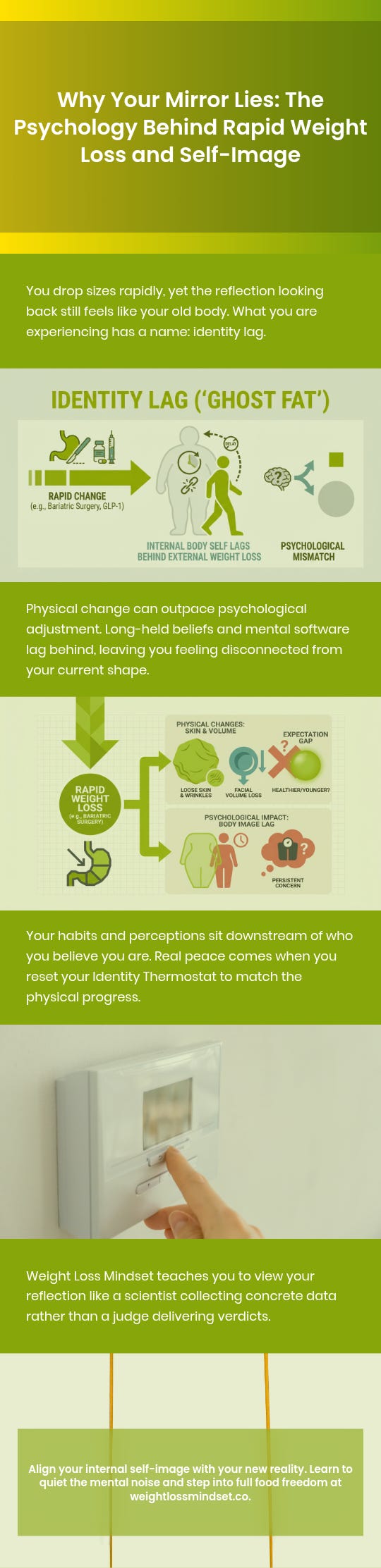
You lost the weight, so why does your reflection still feel wrong? Researchers call it phantom fat, and your brain’s internal body map can take over a year to catch up with reality.

Key Takeaways
Rapid weight loss can cause a real psychological gap, sometimes called ghost fat, where a person still feels like their old body despite visible change
The brain’s internal body map updates slowly, and that lag can show up as mirror checking, scale fixation, or constant fear of regaining weight
Restriction and sheer effort tend to widen the gap between body and self-image instead of closing it
Identity-focused coaching treats the mental adjustment period as something to support, not rush through
Simple shifts in language and self-talk can help close the distance between a changed body and a self-image that hasn’t caught up yet
Someone can step on the scale, see a number they worked hard for, and still catch their reflection and flinch. That strange gap between what the body has become and what the mind still believes it is has a name, and it happens to far more people than most realize.
The Mirror Lies: Ghost Fat Explained
The sensation of still feeling large after losing a significant amount of weight is sometimes described as “ghost fat,” or phantom fat, a pattern reported after rapid transformations such as bariatric surgery or GLP-1 medication use. People describe reaching for a smaller chair, bracing to squeeze through a doorway, or flinching at a photo that shows a body that no longer matches the one in their head. The physical change happened. The internal picture has not finished updating.
This is not vanity or ingratitude. Two timelines are simply moving at different speeds: the body changes on a schedule set by food, movement, and biology, while self-image changes on a much slower, more stubborn schedule set by years of belief and habit. Weight Loss Mindset approaches this gap as a core part of the weight loss process rather than a strange side effect, holding that lasting change requires working on identity, not just the number on the scale.
Ignoring this gap is a common reason people feel hollow even after reaching a goal weight. The scale says one thing. The mind, still running old patterns, says another. Closing that distance takes more than patience. It takes a different kind of work.
Why Your Brain Lags Behind Your Body
The brain builds a map of the body long before any diet starts, and that map does not erase itself just because the body it was tracking has changed shape.
The Body Schema Catches Up Slowly
The brain maintains something researchers call a body schema, an internal sense of size, shape, and space that the body takes up in the world. This schema forms over years, shaped by every mirror glance, every piece of clothing, every comment from another person. After fast weight loss, the body schema can take a long stretch of time to catch up, with the mental adjustment period lasting anywhere from several months to well over a year, depending on how much weight was lost and how long the previous body shape had been in place.
That lag is not a character flaw. It is a biological reality. A person who spent two decades in a larger body built a body schema over two decades. Expecting that internal map to redraw itself in a few months of weight loss misunderstands how slowly the brain actually updates deep, long-held patterns.
Identity Was Never Rewritten by the Scale
A lower number on the scale changes the body. It does nothing, by itself, to change the identity underneath it. Someone who has spent years thinking of themselves as “the person who always struggles with food” or “the person who can’t stick to anything” can lose a meaningful amount of weight and still carry that same internal label, because the label was never actually about weight in the first place.
Many well-meaning diets fall short here. They focus entirely on the plate and the scale, assuming the mind will simply follow along once the body changes. Identity rarely works that way. A person’s self-concept acts like a thermostat, holding behavior and self-perception at a familiar setting even after the external environment, including body shape, has shifted. Resetting that internal setting matters just as much as any change on the plate.
Signs the Gap Is Affecting You
The identity lag between body and self-image tends to show up in a handful of recognizable patterns, often before someone realizes what is actually going on underneath them.
Mirror Checking and Scale Fixation
Increased scrutiny of the body, including repeated mirror checking, obsessive scale use, and constant comparison between old and new photos, is a well-documented response during periods of major body change. Small perceived flaws can start to feel magnified, almost as if the mind is searching for proof that the old body is still in there somewhere. A person might lose a meaningful amount of weight and still spend more time critiquing loose skin or a changed face than celebrating the progress made.
Fear of Regain and Meal Anxiety
A strong fear of regaining lost weight is common after significant loss, and it often turns ordinary moments, a dinner out, a weigh-in, a normal daily fluctuation, into sources of real anxiety. When compliments and social approval become tied to a smaller body, maintaining that body can start to feel like constant proof of worth rather than a settled, comfortable new normal. That pressure rarely fades on its own. It tends to grow louder the longer it goes unaddressed.
Shifting Reactions From Others
Self-image does not form in a vacuum. Other people’s reactions shape it constantly, and those reactions often shift dramatically after noticeable weight loss. Some people receive warmer attention, more compliments, more social ease. Others face jealousy, intrusive comments, or a strange shift in how family and friends treat them. Food-focused social situations can become emotionally charged too, as eating differently in front of others sometimes creates isolation or an unspoken pressure to stay perfectly in control at every meal.
Why Willpower Never Closes the Gap
The instinct to simply try harder at managing the body-mind gap tends to backfire, often making the original problem worse rather than solving it.
Restriction Triggers the Slingshot Effect
Leaning on more willpower or stricter restriction to force the mind to accept a new body usually creates the opposite of calm. Restriction builds tension, and tension has a way of snapping back, sometimes called the Slingshot effect. The harder someone pulls back on food, the harder the eventual rebound tends to be, both physically, as hunger hormones spike, and emotionally, as deprivation starts to feel like a threat rather than a choice. Trying to force an identity shift through sheer grit works the same way. The pressure builds until something gives.
Identity Regulates Habits, Not Discipline
Habits and automatic behaviors sit downstream of identity. A person who still privately identifies as someone who struggles with food will keep circling back to struggle, no matter how much discipline gets thrown at the problem, because discipline is fighting the wrong battle. Change the identity underneath the behavior, and the behavior tends to shift without the constant mental fight. This is the logic behind resetting the internal thermostat rather than reaching for another short-term diet.
Closing the Gap Between Body and Self
Closing the distance between a changed body and a self-image still stuck in the past takes a specific kind of work, one aimed at the mind as much as the mirror.
Reset the Identity Thermostat
Diets tend to open a window: a quick fix that lets in some fresh air before the old temperature creeps back in. Resetting the internal thermostat means changing the baseline setting itself, so the new body and the new habits feel like the normal, settled state rather than a fragile exception that has to be defended every single day. That reset tends to come from examining the old identity labels a person has been carrying, often without realizing it, and replacing them with something that actually matches who they are becoming.
Become the Scientist, Not the Judge
A slip-up, a hard day, an old habit resurfacing for an afternoon, means nothing more than a single data point when approached with curiosity instead of judgment. Collecting data instead of delivering a verdict turns a moment of guilt into useful information: what triggered it, what was happening earlier that day, what pattern is repeating. This shift matters just as much for identity lag as it does for food choices, since harsh self-judgment about still “feeling fat” only reinforces the very gap a person is trying to close.
Separate Self-Worth From the Scale
Practicing self-worth statements that have nothing to do with the number on a scale or the size of a clothing tag can help pull self-image out of a body-focused loop. Describing the body in neutral, functional terms, stronger, more mobile, more rested, rather than only appearance-based judgments, slows down a harsh internal narrative and gives the mind new material to work with. Limiting constant before-and-after photo comparisons and reducing social media exposure during a period of rapid change can also quiet some of the noise that keeps the old self-image on repeat.
Both the Body and the Mind Deserve Support
A body can change faster than the mind is ready for, and that mismatch deserves real attention rather than silence or shame. Weight loss programs that treat appearance as the only measure of success tend to leave people feeling strangely empty even after reaching a goal, because the identity work underneath never got addressed. Structured psychological support, including approaches that specifically target the thinking patterns behind body image, has shown real value for people adjusting to a changed body after significant weight loss.
The body deserves support through movement, rest, and nourishment. The mind deserves just as much support while it slowly, steadily catches up to the person already standing in the mirror. For anyone ready to start closing that gap, resources built around identity-first weight loss offer a starting point that treats the mental side of change as seriously as the physical one.