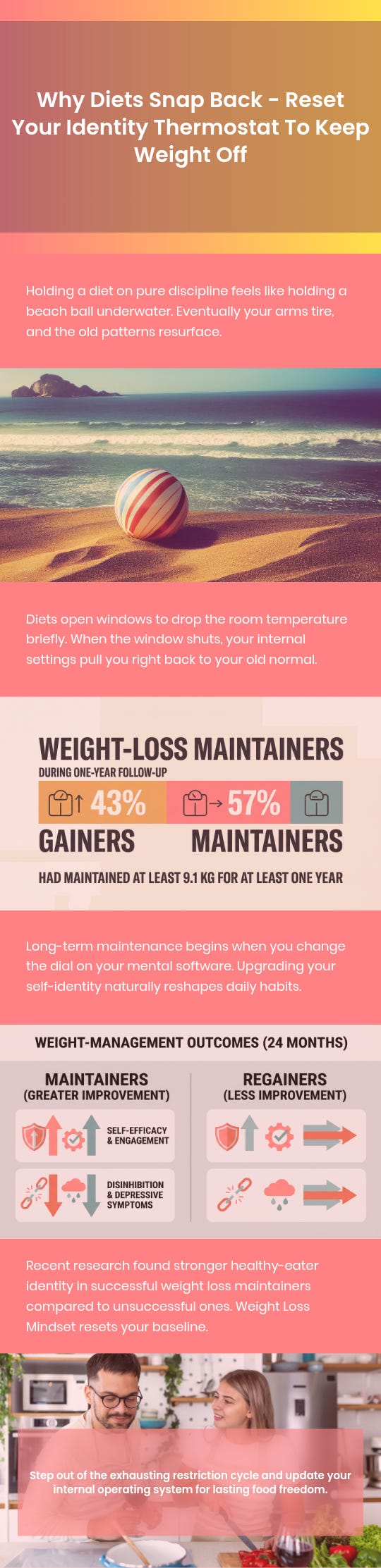
You cut calories, lose weight, then watch it creep back. One study found hunger hormones hadn’t normalized a full year later. What’s really driving that rebound, and what separates people who keep weight off for good?

Key Takeaways
Weight regain after dieting often traces back to biological shifts in appetite hormones and metabolism, not a lack of willpower
One year after weight loss, hormones tied to hunger and fullness can still differ from pre-diet levels, keeping appetite elevated
A ten-year study of people who kept weight off found continued habits like self-monitoring and regular activity separated maintainers from those who regained
Treating slip-ups as data to study rather than moral failures is a core idea behind the identity-based coaching approach from Weight Loss Mindset
The article explains what actually predicts long-term maintenance success, a question many dieters never get a straight answer to
Anyone who has lost weight on a strict diet, only to watch the pounds return, has likely wondered what went wrong. The honest answer has less to do with character and more to do with biology working as it is designed to work.
One Year Later, Hunger Hormones Still Haven’t Recovered
A clinical study led by researcher Sumithran and colleagues followed 50 overweight or obese patients without diabetes who lost a mean of 13.5 kilograms, then tracked their hormones for a full year afterward. Ghrelin, the hormone that signals hunger, rose. Leptin and several other hormones tied to feeling full dropped and stayed down. A year later, those levels still had not returned to where they started, and participants reported feeling hungrier than before they lost the weight.
This reframes a familiar story. Someone who regains weight after a strict diet is often told, directly or indirectly, that they simply did not try hard enough. The research points to something different: the body itself was pushing back, long after the diet officially ended. Weight Loss Mindset builds its coaching approach around this idea, treating the problem as mental and biological wiring rather than a question of personal discipline.
Understanding that hunger can stay elevated for months changes how a setback should be read. A setback is evidence that the body adapted to protect itself, and that adaptation calls for a different kind of response than gritting teeth and trying harder.
Why Restriction Backfires: The Slingshot Effect
Picture pulling a rubber band back as far as it will go. The tighter the pull, the harder the snap when released. Severe restriction works the same way on the body. The harder someone cuts back, the more forceful the rebound tends to be, and that rebound shows up as stronger hunger signals paired with a body that burns fewer calories than expected.
Appetite Hormones Shift After Weight Loss
A review by researchers MacLean and colleagues described this pattern across multiple studies: after weight loss, energy expenditure and leptin tend to drop, while appetite, cravings, and ghrelin tend to rise. A separate review by Hall and Kahan described the same pieces moving together, with reduced satiety signals paired with increased hunger-related signals, working against anyone trying to keep weight off.
A review by Berthoud and colleagues summed up the mechanism plainly. Intentional weight loss can trigger what researchers call counterregulatory hunger, alongside reduced energy expenditure. Both changes work to slow or reverse the weight that was lost, which is why restriction so often produces a pendulum swing rather than lasting change.
Metabolism Slows Below Predicted Levels
Weight loss naturally lowers calorie needs, since a smaller body requires less energy to run. Research suggests something beyond that simple math is often happening too. Hall and Kahan describe this as adaptive thermogenesis, a drop in resting energy expenditure larger than body composition changes alone would explain.
A long-term follow-up study by Fothergill and colleagues tracked 14 contestants from a televised weight-loss competition and found resting metabolic rate was still below predicted levels six years later, even though the study involved a small and unusual group of participants. The pattern lines up with what the hormone research shows: the body does not simply return to its old baseline once a diet ends. It can settle into a slower-burning, hungrier state and stay there for a long stretch of time.
It’s Biology, Not a Lack of Discipline
Put these pieces together and a clearer picture emerges. Someone who diets hard, loses weight, and then regains it is facing a physiological response, not a failing test of character. Hormones shifted. Metabolism slowed. Hunger signals got louder. None of that shows up on a bathroom scale, which is exactly why it gets misread as a personal failing instead of biology.
This is the foundation behind the idea that restriction creates tension, and tension eventually snaps back. Framing food as the enemy and willpower as the weapon sets up a fight that biology is built to win. A different starting point treats slip-ups and regain as signals to study, rather than verdicts on someone’s worth.
What Actually Predicts Successful Maintenance
If biology works against sustained restriction, what actually helps people keep weight off? Long-term research points toward ongoing patterns of behavior rather than any single dramatic effort.
Habits That Separate Maintainers From Regainers
A ten-year observational study of participants in the National Weight Control Registry, led by researcher Thomas and colleagues, followed 2,886 participants, the majority female, who had lost at least 30 lbs (13.6 kg) and kept it off for at least one year. The mean weight loss maintained at ten years was 23.1 kilograms, and more than 87% of participants maintained at least a 10% weight loss at both the five-year and ten-year marks. The same study identified what separated people who kept weight off from those who regained it:
Continued physical activity, rather than tapering off over time
Ongoing dietary restraint, meaning consistent attention to eating patterns
Regular self-weighing, which kept small gains from turning into larger ones
Lower dietary disinhibition, meaning fewer instances of eating past the point of fullness
An earlier review by Wing and Phelan described a similar cluster of habits among people who maintained substantial weight loss: continued self-monitoring, regular physical activity, and consistent eating patterns, carried forward long after the initial weight loss phase ended.
Why Ongoing Support Outperforms One-Time Fixes
A systematic review by Gilmartin and Murphy, covering 13 randomized controlled trials, found that lifestyle interventions addressing both diet and physical activity could sustain weight loss for up to two years when care continued beyond the initial program, though the authors noted the evidence varied considerably across studies. A clinical reference chapter on the topic made a related point: weight regain is common after a typical six-to-twelve month treatment period, and frequent follow-up, including at least monthly counseling, appears to help limit it. The same chapter pointed to long-term contact with a counselor or coach, whether in person or remote, as a strategy tied to better outcomes.
This lines up with a different way of thinking about support. Treating a program as a structure to return to, rather than something with a start date and an end date, places more weight on ongoing contact and accountability than on any single burst of motivation. A 30-day program built around daily writing exercises and community accountability reflects this same principle, giving people a structure to return to rather than a one-time push.
Treating Setbacks as Data, Not Verdicts
A setback after weeks of progress can feel like proof that nothing will ever work. A slip-up carries information rather than a final judgment. Asking what triggered the moment, what was happening beforehand, and what pattern might be repeating turns a discouraging event into something useful.
This is the difference between acting as a judge and acting as a scientist. A judge delivers a verdict: failure, weakness, proof of brokenness. A scientist collects data: what happened, when, and why, then uses that information to adjust course. One customer who went through a 30-day identity-focused program described her thinking shifting within the first few days, before her eating habits changed at all. She finished all 30 days of daily writing exercises, something she said was not her usual pattern, and described feeling lighter and more free by the end. That shift in thinking, happening before any change on the plate, reflects the idea that behavior tends to follow identity rather than the other way around.
Weight Regain Is a Biological Pattern, Not a Personal Failure
The hormone studies, the metabolism research, and the long-term maintenance data all point toward the same conclusion. Weight regain after a restrictive diet is a predictable biological pattern, not a referendum on someone’s discipline or character. Appetite hormones can stay elevated for a year or longer. Metabolism can slow below what body composition alone would predict. The people who successfully maintain weight loss tend to rely on steady habits and ongoing support rather than a single dramatic diet.
Change remains possible. The path that works looks different from another round of severe restriction, and it starts with understanding why the last attempt snapped back in the first place. For anyone ready to approach that pattern differently, learning more about an identity-based approach to weight loss is a reasonable next step.