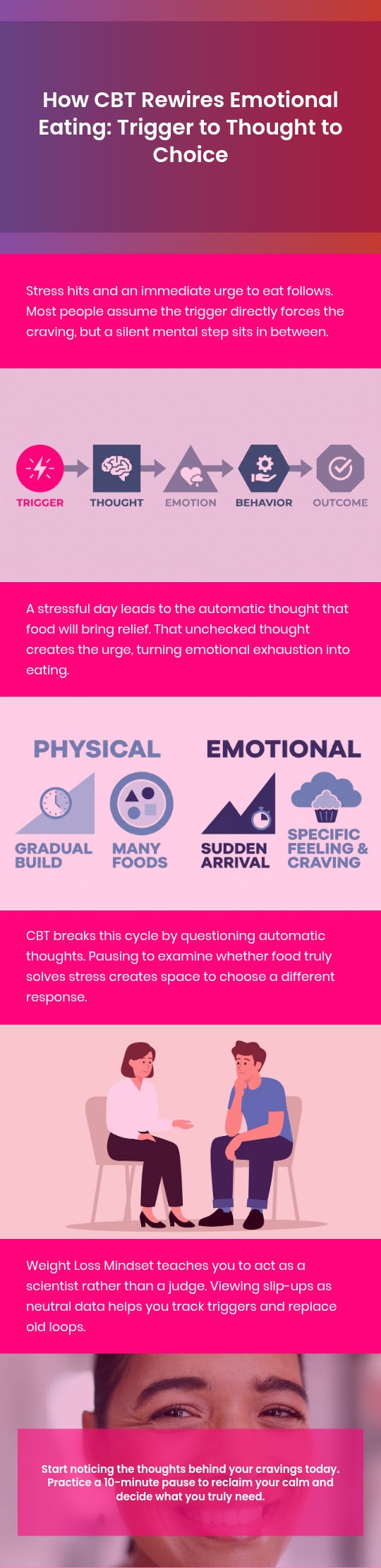
That hand in the pantry after a stressful call isn’t weak willpower, it’s a five-step chain CBT has mapped out. Once you see the links, one surprising pause point can change what happens next.

Key Takeaways
Stress-driven eating often follows a predictable chain: a trigger leads to an automatic thought, then an emotion, then a behavior, and finally a feeling about what just happened
A food-and-mood record that notes what was eaten, how it felt, and what was happening beforehand can reveal the pattern behind an urge to eat
Learning to pause between the trigger and the behavior creates room to question the thought and choose a different response
Treating slip-ups as information to study rather than proof of failure is a mindset that can make the pattern easier to interrupt
A technique called urge surfing can help a craving pass without acting on it immediately
Eating in response to a hard day can feel like it happens before any real decision gets made. One minute there’s a stressful phone call or a wave of loneliness, and the next, a hand is already in the pantry. This isn’t a character flaw or a lack of discipline. Cognitive behavioral therapy, or CBT, has mapped out this sequence in detail, and understanding it is the first step toward changing it.
The Automatic Eating Cycle, Explained
CBT describes a chain reaction that links a situation to an eating behavior: trigger, thought, emotion, behavior, and outcome. A trigger might be a stressful meeting, a lonely evening, or an argument with a family member. That trigger sparks an automatic thought, something like “I need food to feel better.” The thought produces an emotion, often anxiety or a sense of being overwhelmed. The emotion then drives a behavior, which in this case is eating, and the behavior leads to an outcome that can include guilt or renewed stress.
This chain moves fast, which is exactly why it feels automatic rather than chosen. These loops run on mental patterns built from years of repetition, not on weak character. Seeing the steps laid out separately, rather than as one instant blur, is what makes it possible to find a place to pause.
Each link in the chain is a potential point of change. A person doesn’t have to overhaul the whole sequence at once. Learning to notice just one link, like the automatic thought or the emotion underneath it, can be enough to shift what happens next.
Why a Stressful Moment Ends at the Pantry
The path from a bad day to a bag of chips rarely feels like a choice in the moment. It feels more like gravity. Understanding the two middle steps of the cycle, the thought and the resulting spiral, helps explain why that pull feels so strong.
Stress to Thought: ‘I Need Food to Cope’
After a stressful event, the mind often reaches for a quick explanation, and “I need food to cope” is one of the most common ones. This thought isn’t random. It has worked before, at least temporarily, which is why the brain keeps offering it as a solution. The problem is that this thought treats food as the fix for a feeling that food was never designed to solve. A stressful meeting doesn’t actually get resolved by eating; the stress is just muffled for a few minutes.
A more balanced version of that thought might sound like, “I am stressed and want relief. I can take a few minutes to breathe or walk first, then decide if I still want a snack.” This doesn’t deny the craving or the stress behind it. It slows down the jump from thought to action, giving the next two steps in the chain a chance to play out differently.
From Distress to Eating to Guilt
Once the thought takes hold, distress often follows quickly, and eating becomes the behavior that seems to answer it. The trouble is what happens afterward. Eating in response to distress frequently leads to guilt, and that guilt becomes its own source of stress. This creates a loop: stress leads to eating, eating leads to guilt, and guilt leads to more stress, which can trigger eating all over again.
This loop is a major reason diets that rely on restriction and self-criticism tend to backfire. Treating a single eating episode as proof of failure only adds fuel to the next round of distress. Recognizing that the loop exists, separate from any judgment about it, opens the door to interrupting it.
Spotting Your Own Pattern
Before the cycle can be changed, it has to be seen clearly, and seeing it clearly takes more than a vague sense that stress leads to snacking. It takes specific information gathered over time.
Keeping a Food-and-Mood Record
A food-and-mood record is a simple tool for making an invisible pattern visible. The idea is to jot down a few details each time an eating episode happens:
What was eaten and roughly how much
How the feeling showed up before, during, and after eating
What was happening in the moment, such as a stressful event, a quiet evening, or a specific thought
Over a week or two, this kind of record often reveals a repeating trigger, like a certain time of day, a particular person, or a recurring thought. Once that pattern is visible on paper, it stops feeling like a mystery and starts looking like something that can actually be worked with.
Physical Hunger vs. Emotional Hunger
Telling the difference between physical hunger and emotional hunger is another key piece of spotting the pattern. Physical hunger tends to build gradually and relates to how long it has been since the last meal. Emotional hunger usually arrives suddenly and is tied to a need for comfort rather than a need for fuel.
Emotional hunger often comes with a craving for a very specific food, while physical hunger is open to a wider range of options. Noticing which kind of hunger is present in a given moment is one of the clearest signals available for deciding what to do next.
A Pause Point Before You Eat
The whole value of understanding the trigger-to-behavior chain comes down to this: it creates a pause point. An automatic cycle has no built-in pause, and adding one is what makes a different outcome possible.
Name the Trigger and the Feeling
The first move in the pause is simple naming. What just happened right before the urge to eat showed up? What is the feeling underneath it, stress, loneliness, boredom, or something else? Naming the trigger and the feeling out loud or on paper takes some of their automatic power away. A vague sense of “I just need to eat” becomes something more specific, like “I’m anxious because of that email.”
Question the Automatic Thought
Once the trigger and feeling are named, the next step is questioning the thought that connects them to food. Is it fully true that food is the only way to handle this feeling? What else has worked before? One balanced way to reframe an all-or-nothing thought is to treat a single unplanned food choice as one choice, not proof that the whole day is ruined. That reframe matters because the thought a person carries after a slip often determines whether the next meal gets back on track or spirals further.
Choose a Response, Then Observe
With the trigger named and the thought questioned, the next step is picking a response and watching what happens. That response might be a short walk, a few slow breaths, a phone call to a friend, or simply waiting several minutes before deciding whether food is still wanted. Afterward, it helps to note what actually happened: did the urge fade, change, or stay the same? This small habit of choosing and observing turns each craving into a piece of useful information rather than a pass-or-fail moment.
Riding Out a Craving Without Judgment
Some cravings don’t fade after a single pause, and that’s normal. The goal at this stage is to learn how to stay present with the craving until it changes on its own, rather than forcing it away.
Urge Surfing: Watching the Wave Pass
Urge surfing treats a craving like a wave rather than a command. The practice involves noticing where the craving shows up in the body, whether that’s tightness in the stomach, tension in the jaw, or a restless feeling in the hands, instead of fighting the urge or giving in right away. Describing those sensations without judgment, and watching how they shift over a few minutes, often reveals that the craving rises, peaks, and eventually loosens its grip, much like a wave breaking on shore.
This approach doesn’t promise the craving will vanish instantly. It teaches that a craving can be experienced fully without automatically leading to eating, a very different skill from simply trying to white-knuckle through it.
Matching the Coping Action to the Feeling
Not every coping response fits every feeling, and matching the two makes a real difference. A feeling of tension or restlessness might call for physical movement, like a brisk walk or some stretching. A feeling of low energy or sadness might call for something more comforting or restful, like sitting quietly, listening to music, or reaching out to a friend. Picking a response that actually matches the emotion underneath the craving tends to work better than reaching for a generic distraction that doesn’t address what’s really going on.
Writing a short plan ahead of time, even just a few lines on a phone note, gives a ready reference the next time a craving shows up. Having that plan available in the moment removes the pressure of figuring out a response while already feeling overwhelmed.
Data, Not Verdicts, Changes the Pattern
Every piece of this process, naming the trigger, questioning the thought, choosing a response, and watching what happens, works best when it’s treated as information rather than a test to pass or fail. Approaching a slip-up as data collection rather than a moral failure keeps the door open to trying again without the extra weight of shame. That shift in framing, from judge to observer, is often what makes it possible to notice patterns clearly enough to actually change them.
For anyone ready to put this pause-and-observe approach into daily practice, Weight Loss Mindset offers resources built around this same identity-first approach to breaking automatic eating patterns.