Why does that late-night snack keep happening? Your food journal might be hiding the answer in plain sight, but experts say timing, mood, and one specific tracking window reveal patterns most people miss entirely.

Key Takeaways
A food journal and a therapist play different but complementary roles: the journal records what happened and how it felt, while a therapist helps interpret the patterns underneath
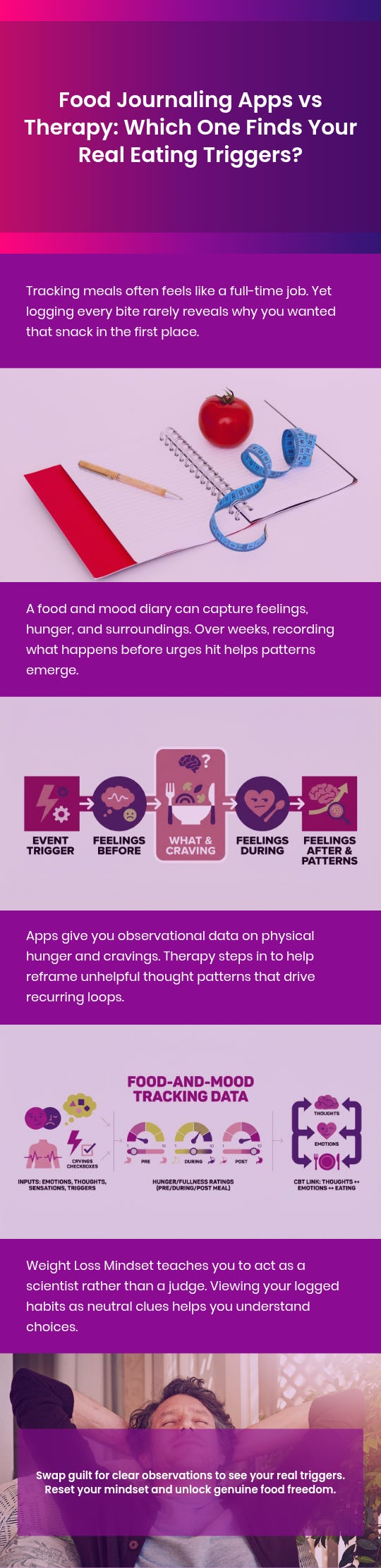
Recording hunger, mood, and the situation before, during, and after eating reveals patterns that a food-only log misses
Tracking is most useful over several weeks, since one or two entries rarely show a clear pattern of what sets off a craving
People with a history of disordered eating should watch for tracking that turns into calorie-focused scrutiny rather than pattern-spotting
Treating eating patterns as data to examine rather than a verdict to pass on oneself can make the whole process less discouraging
Recurring eating patterns can feel like a mystery, especially after years of diets that focused on food alone and never asked why a craving showed up in the first place. Two tools tend to come up when people try to get to the bottom of it: a food journal and a therapist. Each one does something different, and understanding how they fit together can make the search for triggers far less frustrating.
What Your Food Log Can Reveal
A food journal is often dismissed as just a list of meals, but a well-kept one can act more like a detective’s notebook. When it includes the moment just before eating, the feelings during the meal, and the aftermath, it starts to show connections that are easy to miss in the moment. Weight Loss Mindset frames this kind of self-tracking as collecting data rather than passing judgment on oneself, and that framing changes how the information gets used once it is written down.
The value isn’t only in what landed on the plate. The story around the eating matters just as much: the stressful phone call before the pantry raid, the boredom on a slow Sunday afternoon, the argument that preceded a trip to the kitchen. A log built around these details turns scattered memories into a pattern someone can actually work with.
What A Food Journal Actually Captures
A useful journal goes beyond the plate. It captures the surrounding circumstances that often explain why an eating episode happened at all, and those details make the difference between a log that sits unused and one that actually teaches something.
Time, Place, and Company
Noting the time of day, the location, and who else was around at the moment of eating can expose patterns that feel invisible day to day. Someone might notice urges cluster late at night at home, or always seem to follow a particular coworker’s visit to the break room. A log that tracks location and company alongside food and drink can help identify these cues even when the person is not physically hungry.
Hunger and Mood Before, During, After
Rating hunger and mood at three points - before eating, during eating, and after eating - helps separate physical hunger from emotional hunger. A food-and-mood diary that records the upsetting event beforehand along with feelings during and after the meal tends to reveal far more than a diary that only lists what was eaten. Writing these details down right after a meal, rather than trying to remember them hours later, usually produces a more accurate picture and makes the habit easier to stick with.
Spotting Patterns Over Several Weeks
One day of entries rarely tells the full story. Keeping a diary for several weeks tends to be what reveals a pattern tied to a particular place, situation, or emotion. Many self-monitoring approaches suggest a full week of daily entries followed by three more weeks of tracking, giving enough entries to spot whether urges show up at a certain time of day, after contact with specific people, or following a particular mood like anxiety or boredom.
Where Therapy Fits In
A journal is excellent at capturing raw material, but making sense of that material is where a therapist’s training becomes valuable. Cognitive behavioral therapy, in particular, is built around identifying the links between thoughts, emotions, and eating behavior, then working on both the thought patterns and the habits that follow them.
Connecting Thoughts, Emotions, and Eating
A therapist can look at a string of journal entries and spot threads the person living through them might miss, like a thought pattern that shows up right before every emotional eating episode. This is often where the real shift happens: once the thought or belief driving the behavior becomes visible, it becomes much easier to challenge or replace.
Sharing a Journal Between Sessions
Bringing a food-and-mood log into a therapy session gives both the client and the therapist a shared reference point. A log that records time, feeling, food, and response between appointments turns vague memories into something concrete both people can review together, making tracking change over time far more reliable than relying on recall alone.
Narrowing Down Priority Triggers
Once a few weeks of entries exist, a therapist can help narrow the list down to a small number of priority triggers rather than trying to tackle everything at once. A trigger worksheet built around three priority triggers, each one connected to the eating that follows it, makes it possible to choose one or two strategies that actually fit the pattern instead of guessing at a general fix.
Apps, Paper, or Both
The format of the tracking matters less than the consistency of it, but each option has strengths worth knowing about before picking one.
Real-Time Logging With an App
A smartphone app can capture emotions and eating details in the moment, cutting down on the memory gaps that creep in when entries get written hours later. Logging close to the moment it happens tends to produce more accurate hunger and mood ratings, since recall fades fast once the moment has passed.
Why a Simple Paper Log Still Works
A notebook or printed worksheet works just as well for many people, removing any worry about notifications, screens, or apps that feel too clinical. A paper diary can capture the same details an app does: time, food, location, company, mood, and hunger, all written in a format that feels like a personal notebook rather than a tracking tool.
When Tracking Becomes The Problem
Tracking is meant to build understanding, not pressure. When it starts to feel like a test to pass or fail, it has drifted from its original purpose.
Watching For Calorie-Focused Scrutiny
For someone with a history of disordered eating, tracking calories and exact amounts can be risky rather than helpful, and may even trigger a relapse into old patterns. A journal built around mood, location, and the story behind the eating avoids that risk while still producing useful information, since the goal is to understand a decision rather than measure it against a number.
Collecting Data Instead Of Delivering Verdicts
A pattern of late-night snacking after a stressful day is a signal pointing toward a specific trigger worth examining calmly, not a character flaw to confess. Approaching the log as a scientist gathering evidence, rather than a judge handing down a verdict, keeps the process useful instead of discouraging, and makes it far more likely someone sticks with it long enough to see a real pattern emerge.
Patterns Are Information, Not Verdicts
A food journal and a therapist serve different purposes, but together they cover more ground than either one alone. The journal gathers the raw details: time, place, company, hunger, and mood. A therapist helps connect those details into something actionable, narrowing a long list of possible triggers down to the few that matter most. Neither tool works as a scorecard, and the moment tracking starts to feel like scrutiny instead of curiosity is the moment it is worth stepping back and adjusting the approach.
For anyone ready to start noticing these patterns without turning the process into another diet, a simple food and mood tracker focused on feelings and context rather than calories is a reasonable place to begin.