

Ever eat in secret, then punish yourself with stricter rules afterward? That shame-fueled cycle isn’t a willpower failure, it’s a recognizable pattern researchers can actually measure. Here’s why fighting cravings harder backfires, and what actually breaks the loop.

Key Takeaways
Real food addiction shows up as intense cravings, loss of control, secret eating, and emotional distress, not simply a lack of discipline
Restriction often backfires by triggering what’s known as the Slingshot effect, where deprivation snaps back into compulsive eating
Highly palatable foods trigger the same brain reward pathways as addictive substances, making cravings a brain chemistry issue rather than a character flaw
Shame keeps secret bingeing and punishment cycles alive, while replacing judgment with curiosity opens the door to lasting change
One identity-based coaching approach reframes recovery around resetting self-identity rather than tightening willpower, a shift explored further below
Feeling like food has a grip that never loosens is not a character flaw. Real food addiction shows up in specific, recognizable patterns, and recovery depends on understanding those patterns rather than fighting them with more discipline.
The Real Signs of Food Addiction
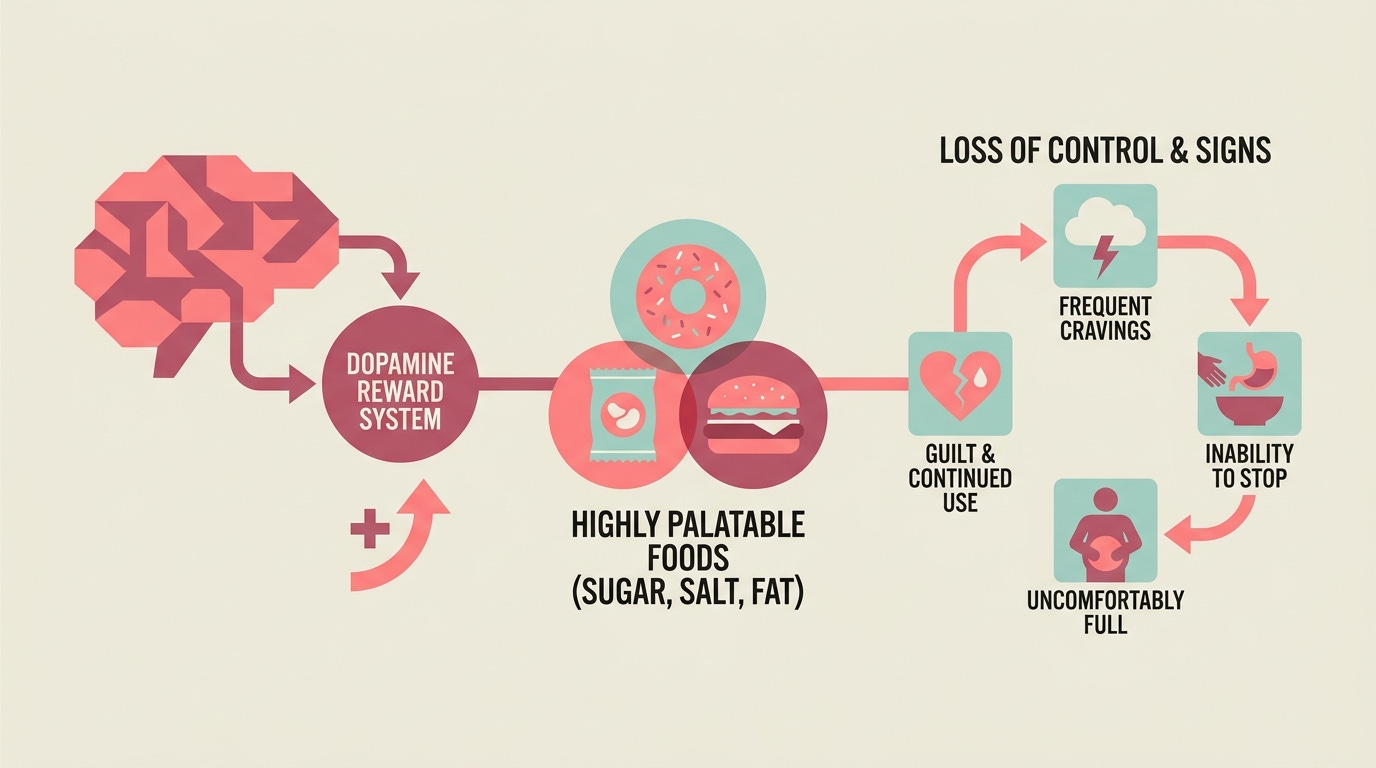
Food addiction rarely looks like what people picture. It looks like eating past fullness on autopilot, feeling unable to stop once the first bite happens, or planning an entire day around when the next “release” of food will happen. It looks like intense cravings that show up out of nowhere, a sense of losing control around certain foods, and real emotional distress tied to eating, something closer to grief or panic rather than mild regret.
These patterns often overlap with trauma responses, chronic stress, and conditions like anxiety or depression, since food frequently becomes the fastest available coping tool. Researchers have even built a clinical measure, the Yale Food Addiction Scale, to quantify how severe these patterns get, treating food addiction as a genuine disorder rather than a personal weakness. That distinction matters, because it reframes the entire conversation: the issue is a set of measurable behaviors with measurable consequences, not a moral failure.
Recognizing these signs is the first real step toward change. Weight Loss Mindset built its coaching approach around helping people over 40 spot these patterns without shame clouding the picture. Instead of asking “what’s wrong with me,” the more useful question becomes “what pattern is running here, and where did it start?”
Why Willpower Alone Always Fails
Willpower gets sold as the missing ingredient, the thing a person needs more of to finally succeed. Willpower was never built for a 24/7 fight against biology, though. Picture holding a beach ball underwater: the arms can manage it for a while, but eventually they give out, and the ball does not float up gently. It launches. That is what tends to happen after weeks of gritted-teeth restriction meet one bad evening.
Restriction and the Slingshot Effect
Restriction promises balance but delivers tension instead, and tension always looks for a way to release. Cutting out entire food groups or slashing calories triggers a physiological alarm: hunger hormones spike, blood sugar crashes, and the brain reads deprivation as a threat. Restrictive dieting can raise the risk of binge eating, and chronic dieting is a known predictor of binge episodes, since cycles of deprivation and overeating tend to become psychologically ingrained over time. The harder the pullback, the harder the snap forward.
How Highly Palatable Foods Hijack Brain Chemistry
Foods engineered with heavy sugar, fat, and salt do not just taste good; they trigger the same brain reward pathways activated by addictive substances. Dopamine floods the system, reinforcing the urge to seek that food out again, and over time the brain’s ability to regulate those cravings weakens. Resisting stops feeling like a choice and starts feeling nearly impossible, because repeated exposure to highly processed foods rewires the very circuits responsible for self-control. This brain chemistry reframes cravings as a learned, reinforced loop operating largely outside conscious awareness, rather than proof of weak character.
Shame Keeps the Cycle Alive
Shame convinces a person they are fundamentally flawed, rather than simply struggling with a hard problem. That belief pushes people into isolation, away from support, and directly away from asking for help, which is often the one thing that could interrupt the cycle early.
Secret Bingeing and the Punishment Loop
Eating in secret is one of the clearest signals that shame has taken hold. The behavior hides because the perceived loss of control feels unbearable to reveal, not because the food itself carries any real shame. What follows is a predictable, punishing sequence: the binge happens, shame arrives, self-punishment follows in the form of stricter rules or harsher self-talk, and that added pressure sets up the conditions for the next binge. Replacing that judgment with compassion marks a key turning point for breaking the loop, since punishment adds another layer of pain on top of the original trigger instead of resolving it.
Emotional Eating’s Hidden Habit Loop
Emotional eating starts as a simple discovery: food makes uncomfortable feelings quieter, at least for a moment. Stress, sadness, loneliness, and boredom all become triggers, and the craving that follows usually points toward high-fat, sugary foods rather than something plain and unremarkable. That specificity is a clue. The brain is asking for a familiar chemical response, not nourishment.
When Food Becomes the Coping Tool
Every time food soothes a hard emotion, the brain strengthens the connection between the two, turning an occasional comfort into an automatic habit loop. Feeling triggers craving, craving triggers eating, eating brings brief relief, and relief reinforces the entire sequence for next time. Over months or years, this loop runs so automatically it barely registers as a decision at all. Breaking it requires noticing the moment between the feeling and the reach for food, since that gap is where change actually becomes possible.
Recovery That Targets Identity, Not Just Behavior
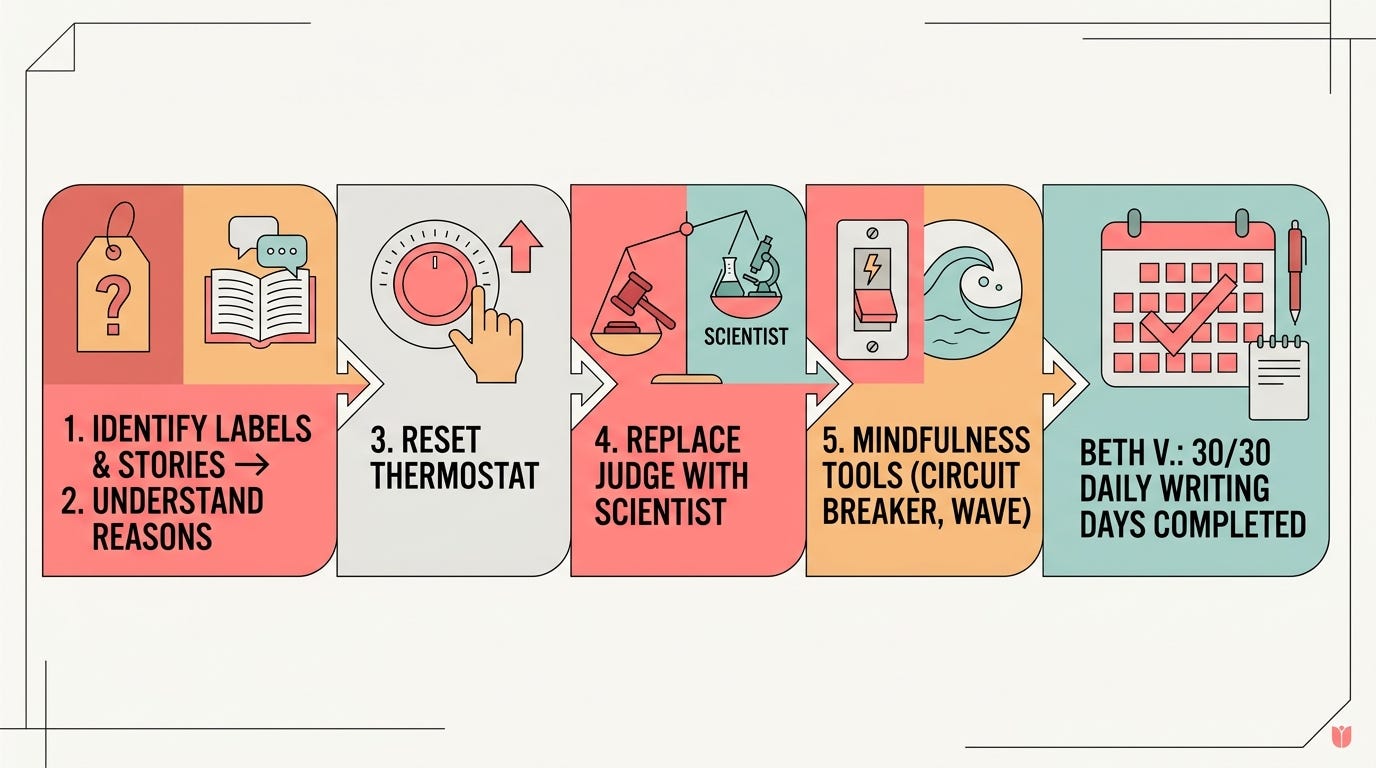
Meal plans and calorie targets treat behavior as the problem, but behavior is usually just the visible tip of something running much deeper. Recovery that lasts tends to involve rebuilding a person’s sense of self around food, forming an identity that feels authentic rather than constantly at war with cravings. Identity is closely tied to how people eat, and lasting change tends to stick once new behavior becomes central and salient to how someone sees themselves, rather than something they are constantly trying to force.
Resetting the Identity Thermostat
Diets function like opening a window when a room gets too hot, a quick fix that does nothing to change the actual temperature setting. A more durable approach resets the thermostat itself: the underlying identity that quietly regulates habits, cravings, and food-related decisions in the background. Once someone stops identifying as “a person who always fails at diets” and starts identifying as someone who studies their own patterns, old habits tend to loosen without a constant fight.
Becoming the Scientist, Not the Judge
A judge delivers verdicts. A scientist collects data. That shift in posture changes everything about how a slip-up gets processed: instead of “I ruined everything again,” the question becomes “what happened right before that moment, and what does it teach me?” This mirrors what mindset-focused recovery approaches generally recommend, replacing rigid self-judgment with honesty, accountability, and realistic hope, since progress in food-related change takes time and rarely moves in a straight line.
Interrupting Cravings in Real Time
Cravings feel enormous in the moment, but they behave more like electricity than an unstoppable force: present, powerful, and temporary. Practical ways to interrupt that surge include:
Naming the craving as data to observe, rather than a command that must be obeyed
Pausing for several slow breaths before deciding whether to act
Picturing the urge as a wave that rises, peaks, and eventually breaks, while the sense of self stays steady underneath it
Asking what emotion might be sitting underneath the urge before reaching for food
These small interruptions create enough space for a different response to become possible.
Freedom Comes From Understanding, Not Discipline
Real recovery from food addiction rarely comes from tightening the rules or trying harder at the same restrictive approach that failed before. It comes from understanding the biological and emotional wiring behind the behavior, removing the shame that keeps the cycle hidden, and building an identity that no longer needs food to regulate every hard feeling. That path requires a clearer picture of what has actually been happening all along, rather than more discipline.
For anyone ready to look at these patterns without judgment, weight loss without willpower is worth checking out to see what a shame-free, identity-based approach looks like in practice.