Something happens before you reach for the food.
Not the reach. Not the bite. Something before all of that.
A feeling moves through you. Stress, or boredom, or a habit-shaped pull with no clear feeling attached to it at all. And then, almost before you’ve registered it, your hand is already moving.
That gap between the feeling and the reach is real. It exists. Most of us have just never learned to look for it.
That’s what this episode is about.
THE ENEMY
The reactive mind doesn’t pause.
It connects stimulus to response the way a reflex connects a tap on the knee to a kicking leg. Fast. Automatic. Bypassing the thinking brain before you’ve had a single conscious thought about it.
That’s what automaticity does. It runs the pattern so smoothly that there’s no felt sense of choosing. Just doing. Arriving at the kitchen without quite knowing how you got there, finishing the bowl and wondering when that happened.
The reactive mind isn’t broken. It’s efficient. But efficient and free are two different things.
Most of our eating happens in that gap between efficient and free. And we’ve never been taught how to step into it.
THE CORE SHIFT
Between every craving and every bite, there is a gap. Between every uncomfortable feeling and every automatic reach toward food, that gap exists. A window, however narrow, between what happens to you and what you do next.
Viktor Frankl, who survived conditions most of us can’t imagine, wrote that the last of the human freedoms is the ability to choose your response to any given situation. Not control what happens. Choose what comes after.
That pause is where agency lives.
Most of us have never found that gap because the reactive mind closes it so fast it seems like it was never there. But it was. It always is. And mindfulness is the practice of finding it, and then widening it, one moment at a time, until it becomes a reliable place for choice.
We’re not trying to think our way out of cravings. We’re learning to catch them before they run.
THE FRAMEWORK
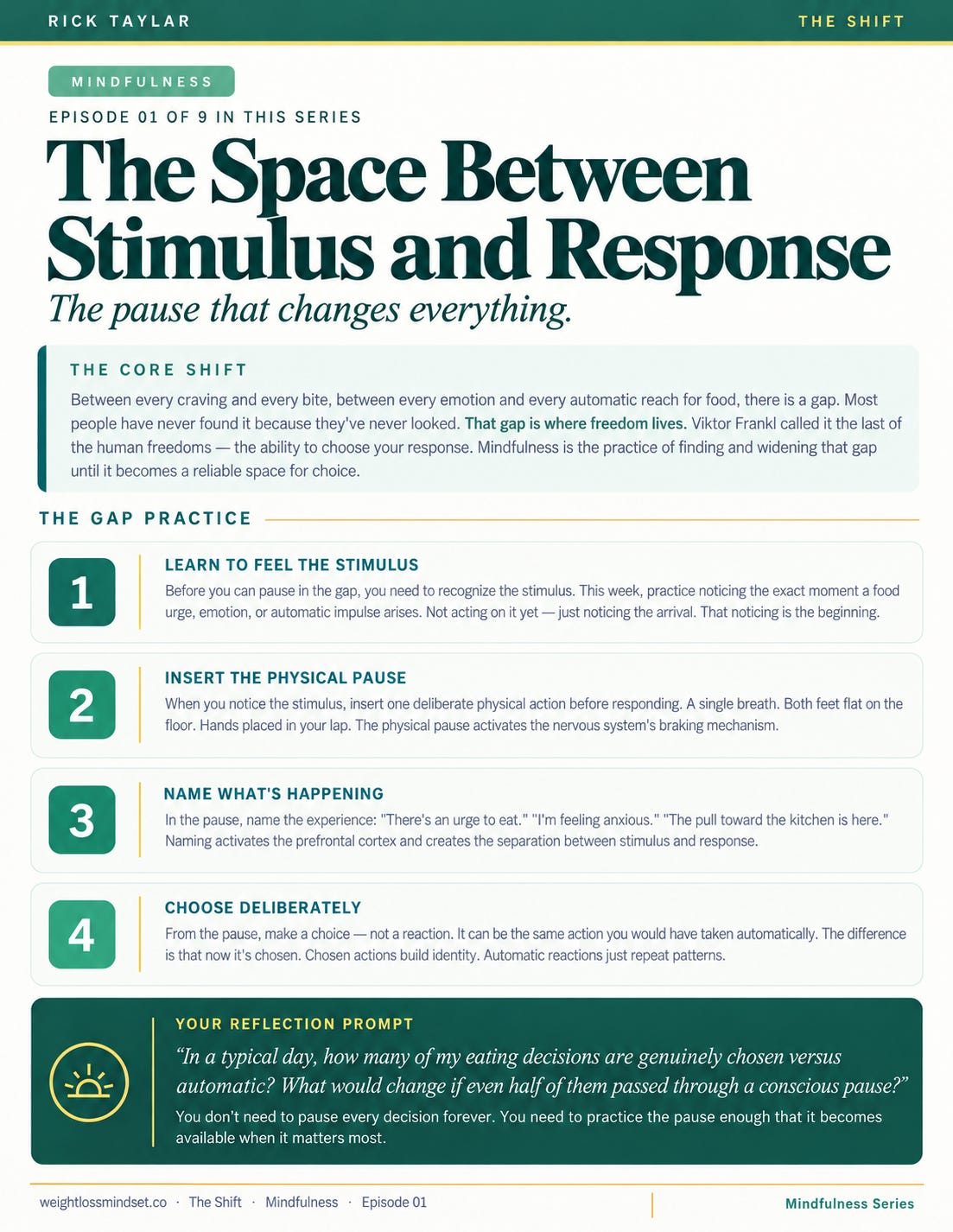
The Gap Practice has four steps.
They’re quiet. They don’t require a meditation cushion or a silent room. They require attention, and then a little more attention, practiced in the middle of ordinary moments.
The first is learning to feel the stimulus arrive.
Before we can pause in the gap, we need to recognize the exact moment a food urge or emotional pull shows up. Not acting on it. Just catching it. That simple act of catching it is the beginning of the whole practice.
Once you can feel it coming, everything else becomes possible.
The second step is inserting a physical pause.
One deliberate action before responding. A single breath. Both feet pressed flat on the floor. Hands placed in your lap. Something concrete and physical. Because the body has a braking mechanism, and a conscious physical act is what trips it.
In that pause, we do the third step: we name what’s happening. Out loud, or written down, or just silently to ourselves:
“There’s an urge to eat.” “Anxiety is here.” “The pull toward the kitchen has arrived.”
Naming creates a small but real distance between the stimulus and you. You become the one observing the urge, not the one being swept along by it. That distance is the gap widening.
And the fourth step is choosing deliberately.
From the pause, we make a choice. It can be the same action we would have taken on automatic. Sometimes it will be. What changes is that it’s now chosen rather than reflexive. Chosen actions build identity. Reflexive ones deepen the groove.
All four steps are in the framework for this episode. It’s below. Return to it during the day, not just here at the end of a listen.
You don’t need to pause every decision you make from now on. That’s not what this is asking.
You need to practice the pause enough that it’s available when it matters most.
The gap is always there.
We’re just learning to live in it.
To subscribe and get all current and future episodes of The Shift, click here
https://news.weightlossmindset.co/subscribe
Today’s Framework