

You blame yourself every time the weight comes back, but what if that regain is exactly what gyms, apps, and even GLP-1 drug makers are counting on? One $62 million settlement reveals how the math actually works.

Key Takeaways
Between 80% and 90% of people who lose weight through non-surgical methods regain most of that weight over time, and that regain fuels repeat business across the weight loss industry
The U.S. weight loss market was valued at $135 billion in 2025, with revenue models built around customers returning again and again rather than succeeding once and leaving
Noom agreed to pay $56 million in cash plus $6 million in subscription credits, a total settlement value of $62 million, over claims it used deceptive app design to trap users in hard-to-cancel subscriptions
Rapid weight regain after stopping GLP-1 drugs like Ozempic and Wegovy is a biological response, not a personal failure - trial data found participants regained a mean of 11.6 percentage points of body weight, about two-thirds of what they’d lost, within a year of stopping
This cycle is better understood as an identity problem than a discipline problem, pointing to a different way of thinking about food and body weight
Most people who sign up for a diet program, a gym membership, or a weight loss app genuinely want to succeed. Yet the businesses selling those services often do best financially when customers do not succeed long-term. That is not an accusation of a shadowy conspiracy. It is a pattern documented across subscription apps, health clubs, commercial diet plans, and even the newest weight loss drugs, and it helps explain why so many people over 40 feel stuck in a loop of losing weight, regaining it, and blaming themselves for the relapse. Weight Loss Mindset has spent years examining that self-blame cycle and argues the problem was never a lack of willpower in the first place.
80-90% Regain: The Industry’s Hidden Engine
Long-term data on non-surgical weight loss paints a consistent picture: somewhere between 80% and 90% of people who lose weight regain most of it over time. Trial data following people who stopped semaglutide after 68 weeks found they regained a mean of 11.6 percentage points of body weight within about a year of stopping, roughly two-thirds of what they had lost, along with a reversal of the blood pressure and blood sugar improvements the drug had produced.
That statistic functions as far more than a sad footnote. It functions as the engine that keeps the entire commercial weight loss system running. When a diet plan, app, or program actually delivers permanent results, the customer has no reason to come back. When regain happens instead, that same customer becomes a repeat shopper, often moving from one program to the next while blaming personal failure rather than questioning the method itself.
A $75 Billion Market Built On Repeat Buyers
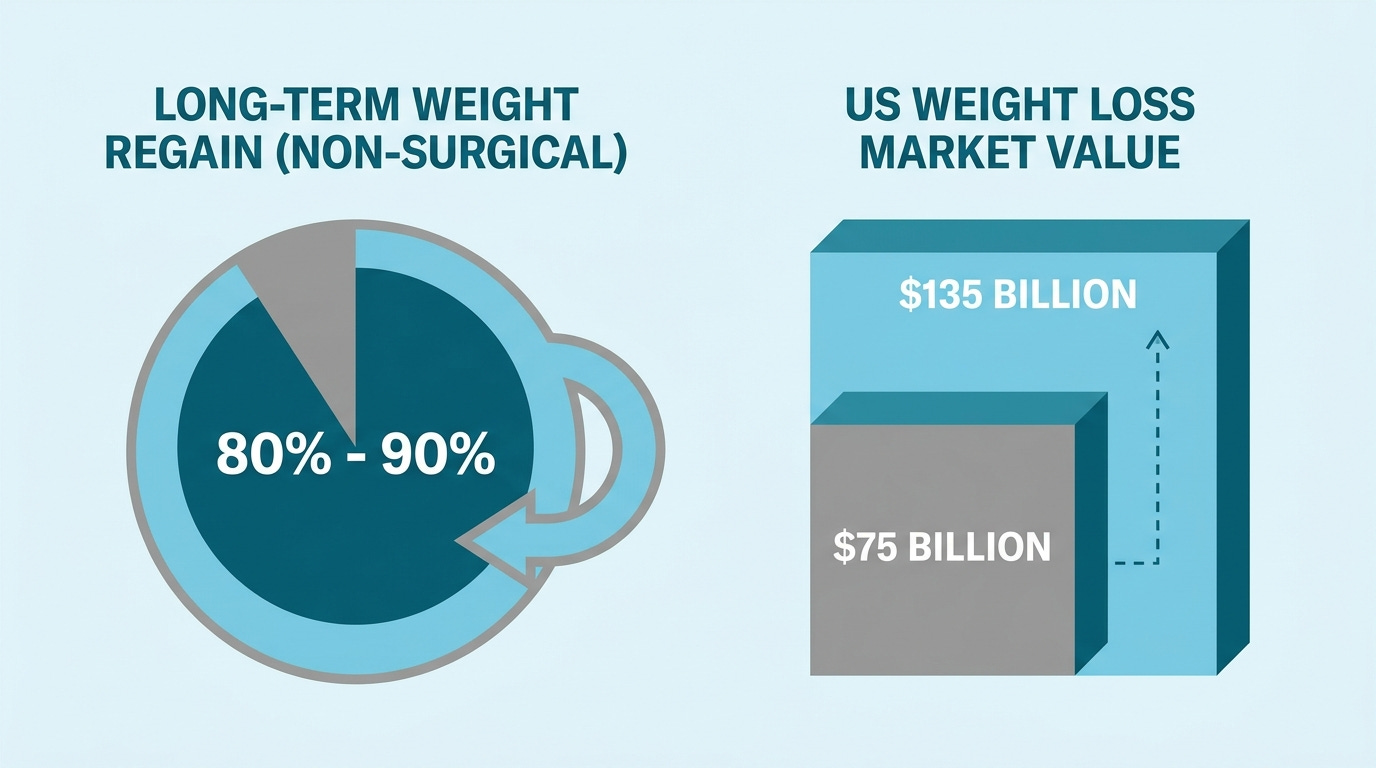
The U.S. weight loss market was valued at $135 billion in 2025. That is a market shaped less like a typical business, where happy customers buy once and recommend the product to friends, and more like a treadmill where the same customers cycle through again and again.
Three business metrics explain why this matters so much to the companies involved: customer lifetime value, average revenue per user, and churn rate. All three improve when a customer sticks around for years, whether that means staying subscribed, re-enrolling after a lapse, or returning for a new round of a program after regaining weight. A customer who loses weight once and keeps it off permanently exits that revenue pipeline for good, which is precisely the outcome the underlying business math does not reward.
Many companies in this space genuinely want customers to succeed. The structural incentive, though, still tilts toward repeat engagement rather than one-and-done success, and that tilt shapes product design even when nobody intends it to.
How Dark Patterns Trap Dieters In Subscriptions
Digital weight loss apps added a new layer to this environment: the subscription. Once a weight loss tool lives inside a recurring billing relationship, keeping a customer enrolled becomes just as valuable as helping that customer lose weight, sometimes more valuable. Some companies have used subtle interface tricks, often called dark patterns, to make signing up easy and canceling difficult.
Noom’s $62 Million Settlement
A class action lawsuit against the app Noom alleged exactly this kind of design. Court filings claimed the company locked users into non-refundable, auto-renewing subscription plans after offering “risk-free” trial periods priced between roughly $1.00 and $18.37. Once a trial ended, billing reportedly shifted to multi-month packages costing up to $199.00, and cancellation required going through virtual coaches who were often slow to respond or unable to process the request.
A federal court approved a settlement in the case: Noom agreed to pay $56 million in cash restitution plus $6 million in subscription credits, for a total value of $62 million. The settlement also required Noom to add clearer auto-renewal disclosures, a standalone consent checkbox, advance billing emails, and a direct online cancellation option. The case became one of the clearest public examples of how subscription design, not just diet content, can shape whether a customer stays enrolled.
FTC Crackdowns On Deceptive Claims
The Federal Trade Commission has been policing weight loss advertising since 1927 and has brought more than 260 enforcement actions since then. Campaigns like Operation Waistline in 1997 and Operation Failed Resolution in 2014 targeted supplement makers and fad diet programs making claims with no scientific backing, with the 2014 effort alone returning nearly $34 million to consumers.
The agency’s “Gut Check” guidance lays out seven claims considered presumptively false, including promises of substantial weight loss regardless of diet, guarantees of permanent results after a product is stopped, and claims that a product blocks fat absorption. These claims persist in advertising anyway, largely because the penalties companies face tend to be smaller than the subscription revenue those same claims generate.
Gyms And GLP-1s Share The Same Playbook
Health clubs and new weight loss medications look nothing alike on the surface. Underneath, both rely on a version of the same business logic: price and design the offer so that non-use, rather than regular use, keeps the revenue flowing.
Why Low-Cost Memberships Bank On Absence
Budget gym chains often charge somewhere between $10 and $25 a month, a price low enough that it rarely triggers a closer look at a household budget, yet guilt-inducing enough that members hesitate to cancel even when they stop showing up. That pricing strategy only works because most members do not actually use the facility regularly.
A typical commercial fitness center spans 20,000 to 30,000 square feet with a safe capacity of maybe 300 to 500 people at once. Many clubs enroll thousands of active members per location. The math only holds up because attendance drops off sharply, often within the first couple of months of a new membership, keeping facilities from being overwhelmed while recurring dues keep arriving regardless of whether anyone walks through the door.
Rapid Regain After Stopping Ozempic And Wegovy
GLP-1 drugs like Ozempic and Wegovy represent the newest version of this same pattern, just with a prescription instead of a membership card. As noted above, trial participants who stopped semaglutide after 68 weeks regained most of their prior weight loss within a year, along with a reversal of improvements in blood pressure and blood sugar markers.
Real-world persistence with these drugs is also low. One-year persistence rates for people prescribed GLP-1 medications for weight management rose from 33.2% among people who started in 2021 to 60.9% among people who started in the first half of 2024, with persistence dropping off sharply by the two- and three-year marks. Every person who stops and regains weight becomes a renewed prospect for the broader weight loss market, whether that means restarting the medication, joining a gym, or signing up for a new app.
Why Metabolism, Not Character, Drives Regain
None of this regain happens because people lack discipline. The body actively defends its previous weight through a set of hormonal and metabolic adjustments that kick in after weight loss, regardless of the method used to lose it.
After weight loss, leptin levels decrease while ghrelin levels increase, lowering the signal that tells the brain a person is full while raising the signal that tells it a person is hungry. Resting metabolic rate also slows down more than body composition changes alone would predict, a shift researchers call adaptive thermogenesis. These changes have been shown to persist for at least a year after weight loss, creating ongoing physical pressure to regain weight regardless of how much willpower a person brings to the table.
This is also why increased hunger after stopping a GLP-1 medication reflects a normal biological response rather than a character flaw. The body produces less of the hormones that signal fullness and more of the ones that signal hunger, which makes eating less feel like fighting against the body’s own chemistry rather than simply making better choices.
The Industry Profits When You Blame Yourself
Here is the part that matters most for anyone who has lived through this cycle: when weight comes back, the natural reaction is to blame personal failure rather than question the program. That reaction is exactly what keeps the re-enrollment cycle turning, because a customer who thinks more willpower is the answer goes looking for the next program, the next app, or the next pill instead of asking why the last one did not hold.
This problem is better understood as mental software and brain chemistry than as weak character or missing discipline, and willpower itself works closer to holding a beach ball underwater than a trait some people simply have more of than others. The guiding idea is that identity, not information, drives long-term behavior change, and that slip-ups work better as data to learn from than as evidence of personal failure.
Seeing how the wider industry profits from relapse does not fix regain on its own, but it does reframe what regain actually means. A pattern baked into gym pricing, app subscription design, and drug persistence data is a structural pattern, not a verdict on anyone’s character. For people ready to step off that cycle, looking into an identity-based approach to weight loss can be a useful next step toward understanding why past attempts stalled out, and what a different starting point might look like.