

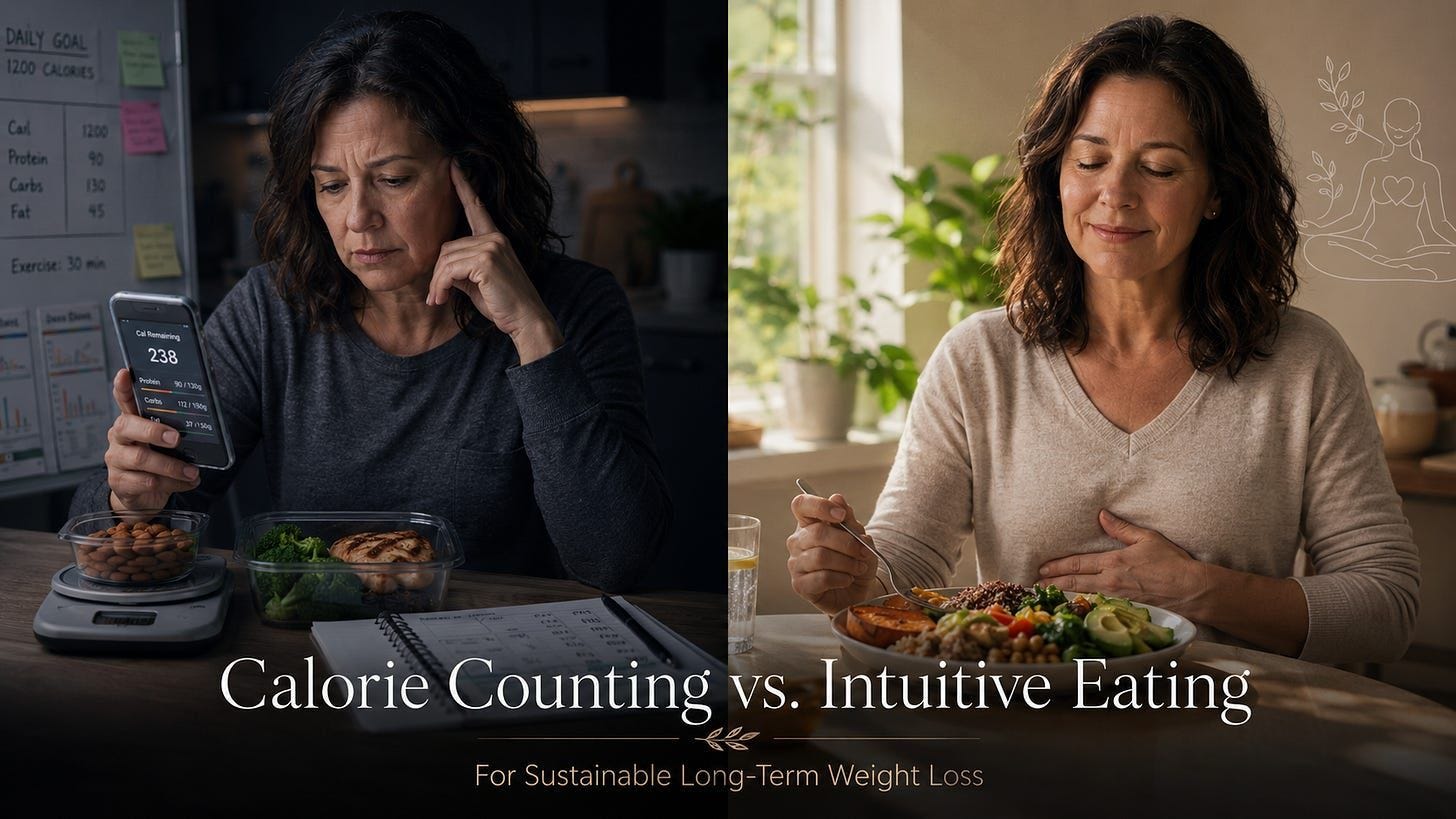
You’ve counted before. The app open at dinner, the mental math over a handful of almonds, the little number that decided whether you’d been “good” that day.
It worked for a while. Then it stopped.
You’re not broken, and you didn’t run out of willpower. The method has a shelf life. More than two years after a diet, around 83% of people gain back more than they lost. After five years, half of dieters are carrying an extra 11 pounds.
So the only test that matters is this: can you still be doing it in 10 years without losing your mind?
Calorie counting: real wins, real wear
Counting does one job well. It forces a deficit, and a deficit moves the scale. If you have a medical reason or a hard deadline, that predictability is genuinely useful. Results come fast, and fast feels like progress.
The trouble starts after the diet ends.
A review and meta-analysis of 80 weight-loss trials found the same arc almost every time: sharp early loss, then a slow climb back up. People who cycle through loss and regain (the yo-yo pattern) often end up heavier than those who never restricted at all. That effect hits women hardest.
A few more from the research:
The hormones fight back. After a diet, ghrelin (your hunger hormone) spikes. The more diets you’ve done, the more stubbornly it stays high, so you carry a low gnaw that a normal meal won’t quiet.
Bans backfire. Diets that forbid specific foods see a 133% jump in overeating those exact foods.
The Biggest Loser proof. Six years after the cameras left, contestants’ bodies were still running slow and pulling the weight back on.
The mental tax. Logging every bite can tip into obsession. In a study of 493 college students, calorie-tracker users showed higher eating concern and dietary restraint, even after adjusting for BMI.
The numbers lie anyway. One study clocked errors up to 760 calories under and 468 calories over. That gap is wide enough to wreck any plan built on precise counting.
Counting works as a short-term tool. The mistake most people make is wearing it like a permanent fix.
Intuitive eating: the upside and the honest catch
Intuitive eating puts your body back in charge: hunger and fullness decide when you stop. There’s a catch, though. Years of dieting scramble those signals, so the real work is rebuilding a compass that restriction broke.
The long-term data looks strong:
An 8-year study found that higher intuitive eating predicted lower odds of depression, low self-esteem, body dissatisfaction, and binge eating. The binge-eating link was the strongest. One point higher on intuitive eating meant 74% lower odds of binge eating at follow-up.
10 of 11 cross-sectional studies found intuitive eaters carry significantly lower BMI than non-intuitive eaters.
A 2024 systematic review tied intuitive and mindful eating to lower disordered eating, better body image, more self-compassion, lower BMI, better diet quality, and more physical activity.
Intuitive eating has one real limitation. A study of 41,536 people found that scoring high on “unconditional permission to eat,” with no rules at all, lined up with more fast food, fewer vegetables, and higher total calories. Total freedom with a broken compass doesn’t get you there either.
A side-by-side look
Short-term loss: counting is fast and predictable; intuitive eating is slower and more variable.
Long-term maintenance: counting struggles (around 83% regain); intuitive eating holds up better.
Hunger hormones: counting raises ghrelin over time; intuitive eating helps restore your natural signals.
Mental health: counting risks obsession and restraint; intuitive eating links to better body image.
Best use: counting works for short-term education; intuitive eating works as a long-term way of living.
Main risk: counting brings burnout and rebound; intuitive eating risks drift without any structure.
The middle ground (and where identity comes in)
You don’t have to pick one and marry it. The strongest evidence backs a blend of both.
You can start with calorie awareness as a teaching tool, the way you’d use training wheels. Learn what a real portion looks like, get a feel for protein and fiber, see roughly where your meals land. Then let go of the logging and shift toward listening to your body.
That handoff is where most people who’ve spent years yo-yo dieting finally stop sliding backward.
The difference goes deeper than tactics. Calorie counting runs on external rules; intuitive eating runs on internal trust. One asks you to follow a system; the other asks you to become a certain kind of person, someone who reads their own hunger and answers it without guilt.
That’s the identity piece. When your self-image shifts from “a person on a diet” to “a person who trusts their body,” you stop white-knuckling every meal. Your daily choices start matching who you believe you are, the way a thermostat pulls a room back to its set temperature. Change the setting, and the choices stop being a fight.
Where to start this week
You don’t need another 30-day cleanse. You need a sequence:
Spend 2 weeks on awareness, not punishment. Note what and roughly how much you eat. No targets, no guilt. You’re gathering data.
Relearn hunger. Before eating, rate your hunger 1 to 10. Eat at a 3 or 4, stop around a 6 or 7. That one habit rebuilds the broken signal.
Drop the logging. Once portions feel familiar, close the app and let your attention move inward.
Build the identity underneath it. Ask one question at meals: “What would a person who trusts their body do here?” Then do that.
Lasting weight loss starts with becoming that person.
Work on the identity layer instead of the next diet, and the eating takes care of itself.
Learn more by signing up for a subscription to Weight Loss Mindset here.