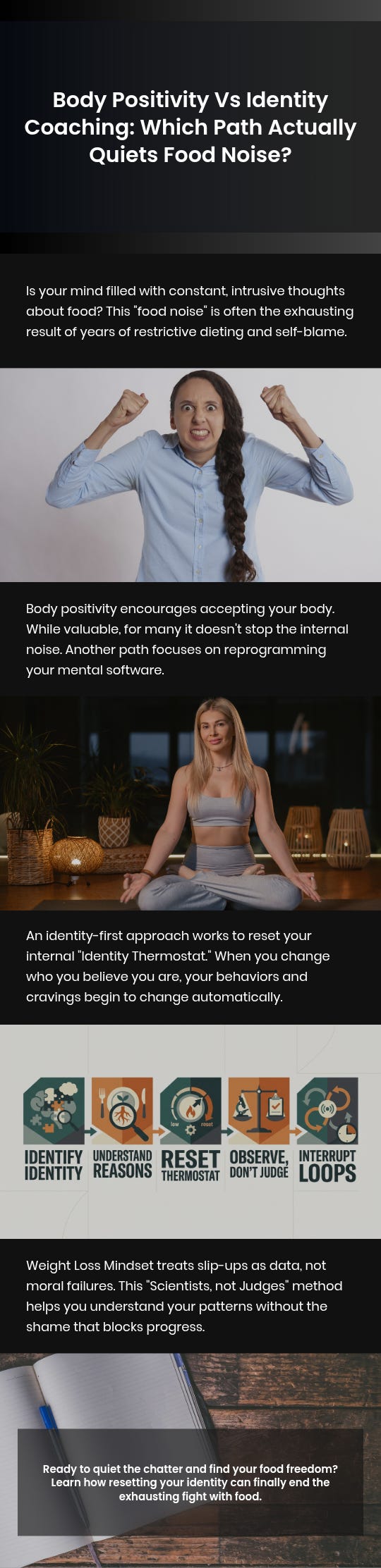
You’ve tried accepting your body, then restrictive diets, and still feel the same inside. There’s a reason both approaches stall out, and it starts with something researchers call the “Slingshot effect.”

Key Takeaways
An identity-first approach targets the belief system behind eating behavior, while body positivity mainly addresses feelings about appearance
Restrictive dieting can trigger a ‘Slingshot effect,’ where hard-won willpower eventually snaps back into the very habits someone was trying to avoid
Self-compassion is linked to reducing body shame and showing appreciation for what the body can do
A 30-day identity-focused program helped one longtime ‘quitter’ complete every single day and drop long-standing eating habits
Lasting self-image change tends to start with how someone sees themselves, not with the number on a scale - a detail worth examining further before choosing a next step
The Real Question Behind Self-Image
Self-image is not a single feeling. It is a mix of perceptions, beliefs, and stories a person tells themselves every time they look in a mirror or step on a scale. Cultural standards, past failures, and years of diet talk all feed into that inner picture, which is why so many people over 40 feel stuck between two camps: love the body exactly as it is, or keep pushing harder to change it.
Both camps promise a better relationship with self-image, but they rarely explain why so many people cycle through them without lasting relief. Someone can recite every body positivity affirmation and still feel a wave of shame after a holiday dinner. Someone else can white-knuckle a diet for months and still see a stranger in the mirror after the weight comes off. The real question is which approach actually rewires the belief system driving daily choices, and Weight Loss Mindset has spent years studying that exact gap between acceptance and action.
This piece compares body positivity, willpower-based dieting, and an identity-first approach, looking at what each one does well and where each one tends to break down for people who have tried diet after diet and ended up blaming themselves.
Where Body Positivity Falls Short
What the Movement Promises
Body positivity set out to challenge narrow beauty standards and encourage acceptance of bodies in every shape, size, and color. The core promise is simple: stop waiting for a smaller body to feel worthy, and start treating the current body with respect right now. For many people, this message is a genuine relief after years of chasing an ideal that never quite arrives, and body positivity has been linked to better mental health outcomes for those who practice it.
A related idea, body neutrality, shifts the focus even further away from appearance. Instead of forcing positive feelings about how the body looks, body neutrality encourages appreciation for what the body can actually do, like carrying groceries up a flight of stairs or keeping up with grandkids at the park. Both approaches share a goal: loosen the grip that appearance has on a person’s sense of self-worth.
Why Acceptance Alone Doesn’t Change Behavior
Acceptance is a valuable starting point, but it rarely addresses the mental patterns that drive eating decisions in the first place. A person can fully accept their body and still feel pulled toward the pantry at eleven at night by habits and emotional triggers that have nothing to do with how they feel about their appearance. Body image is shaped by thoughts, beliefs, and actions, not appearance alone, which means accepting the body without examining the thought patterns underneath leaves a major piece of the puzzle untouched.
This gap explains why some people adopt body positivity messaging and still struggle with disordered eating patterns or persistent negative self-talk around food. Acceptance changes how someone feels about looking in the mirror. It does little to change what happens when stress, boredom, or old habits take over later that evening. A full picture of self-image has to include the behavior patterns running quietly in the background, not just the feelings on the surface.
Why Willpower Diets Backfire
The Slingshot Effect Explained
Restrictive dieting takes the opposite approach from body positivity, trying to force change through discipline and deprivation instead of acceptance. The trouble is that restriction creates tension, and tension has a way of snapping back. Pulling back hard on food intake does not create balance. It builds pressure that eventually releases all at once, often in the form of a late-night binge that feels completely out of control.
This pattern has a name: the Slingshot effect. The harder someone pulls back through calorie counting, keto, or intermittent fasting, the harder the rebound tends to hit. Hunger hormones spike, blood sugar crashes, and the body starts treating deprivation as a genuine threat. None of this is a character flaw. It is closer to physics than psychology, and it explains why willpower-based diets so often end with the exact habits they were meant to eliminate.
Restriction, Shame, and Self-Esteem
Diet culture rarely stops at food rules. It tends to bring a heavy dose of self-judgment along with it, and that judgment chips away at self-esteem over time. Restrictive dieting has been linked to increased stress, anxiety, and body dissatisfaction, which runs directly counter to the goal of building a stronger self-image.
A few patterns show up again and again in people who have spent years cycling through restrictive diets:
Negative self-talk becomes the default response to any slip-up, no matter how small.
Shame after a “bad” eating choice reinforces the belief that the person lacks discipline.
Fear of regaining lost weight often leads to even tighter restriction, repeating the same cycle.
Social withdrawal increases as body shame and weight stigma take a toll on confidence.
Each of these patterns feeds the next one, which is exactly why willpower alone rarely produces a self-image that holds up over time.
The Identity-First Alternative
Resetting the Identity Thermostat
An identity-first approach starts from a different premise entirely: behavior is downstream of identity, not the other way around. Diets function like opening a window to cool down a room for a moment. The temperature creeps back up the second the window closes. Resetting the Identity Thermostat means changing the underlying belief system a person holds about who they are, so new behavior becomes the natural output instead of something forced through sheer effort.
This matters because habits, cravings, and food choices are shaped by the identity labels a person has quietly attached to themselves, often without realizing it. Someone who believes “I always quit after a week” will tend to quit after a week, no matter how good the meal plan looks on paper. Shifting that underlying belief changes what feels normal and automatic, a different mechanism from fighting cravings through willpower alone.
Scientists, Not Judges: Removing Shame
A core piece of this approach involves replacing the Judge with the Scientist. Instead of treating a slip-up as proof of weak character, the Scientist treats it as data worth examining. What triggered the choice? What was happening in the hour before it? What story was running through the mind at that moment? This shift removes the shame spiral that so often follows a setback in traditional dieting.
Replacing judgment with curiosity does not excuse unhelpful patterns. It creates enough safety for a person to actually look at those patterns clearly, the first step toward changing them.
How Identity Change Precedes Behavior Change
The sequence matters more than it might first appear. Traditional dieting asks for behavior change first, hoping that identity and self-image will eventually catch up once the pounds come off. An identity-first approach flips that order. Change the belief about who someone is first, and the day-to-day choices tend to follow naturally, often within the first few days of real work.
This sequencing explains why people can lose significant weight through sheer restriction and still carry the same insecure self-image they started with. Even after substantial weight loss, old self-perceptions can persist unless the underlying identity work happens alongside the physical changes.
Proof From Real Transformation
Beth V., a podcast listener from Roseburg, Oregon, had a familiar pattern: get excited, go hard for a week or two, lose interest, slide back to old habits. She had struggled with several long-standing eating patterns for years, and her challenge was never a lack of information. It was follow-through. Completing a 30-day identity-focused program was not something she expected of herself, given her track record.
By her own account, her thinking began shifting within the first few days, long before her eating patterns changed. She finished every single day of the program without missing a single exercise, something she says plainly is not like her. Several eating habits that had defeated her for years were gone by day 30, and she described feeling “free and light,” a sense of freedom she called surprising and thrilling. When the program ended, she kept going on her own, still reading about identity and mindset independently. Her own words capture the shift best: she stopped being someone who quits and became someone who shows up.
Self-Compassion as a Common Thread
Self-compassion is linked to lower body shame and a greater ability to appreciate what the body can do. Treating setbacks without harsh judgment, rather than piling on criticism, appears to matter more than any single technique or framework someone is working within.
An identity-first approach extends that same spirit of compassion to behavior itself, treating a missed workout or a late-night snack as information rather than a verdict on someone’s worth. That extension matters, because self-image is built from both how someone feels about their body and how they talk to themselves about their choices.
Identity Change Outlasts Acceptance Alone
Body positivity offers genuine relief from the exhausting pressure of chasing an impossible ideal, and that relief has real value for mental health. Willpower-based dieting offers short-term results that too often collapse under the weight of the Slingshot effect, taking self-esteem down with them. An identity-first approach aims at something more durable: changing the belief system that produces behavior in the first place, so the results and the self-image built around them have a chance to last.
These paths are not mutually exclusive, and plenty of people borrow pieces from each. What the research and real-world transformation stories point to again and again is that lasting self-image change tends to start on the inside, with how a person sees themselves, well before it shows up anywhere else. For anyone ready to pursue that path, a closer look at identity-first weight loss psychology is a reasonable next step toward removing shame and replacing restriction with real understanding.