That 9pm kitchen craving feels random, but it probably isn’t. The real fix depends on which of three eating patterns you’re actually dealing with, and most people grab the wrong app for theirs entirely.

Key Takeaways
The right app depends on the real problem: emotional-eating support, mindful or intuitive eating, or structured weight-loss psychology, so matching the tool to the pattern matters more than picking the most popular one
Noom works as an all-in-one option for psychology-based habit change through lessons, food logging, and coaching, though full features require payment and calorie logging may not suit someone prone to restriction
Photo-based journals like Ate Food Journal focus on feelings and context around a meal rather than calories, while apps like Am I Hungry? use a hunger-fullness scale to rebuild awareness of physical cues
Recovery-oriented tools such as Rise Up + Recover and Recovery Record are built for serious patterns like bingeing or body-image distress and work best alongside a clinician, not as a stand-alone fix
Pairing two simple tools, plus a clear sense of when symptoms call for professional support, tends to work better than searching for one perfect app
Scrolling through an app store looking for help with food can feel like its own kind of overwhelming. Some apps count calories down to the gram, some talk about mindfulness, and some sound like they were built for a clinical setting rather than a Tuesday afternoon craving. The right starting point is rarely “which app has the best reviews” and almost always “which problem is actually showing up at 9pm in the kitchen.”
Which App Actually Fits Your Struggle?
No single app works for everyone, because eating struggles rarely look the same from person to person. Someone who finishes a stressful day by finishing a bag of chips without quite remembering deciding to has a different need than someone who wants to stop counting every bite but still craves structure, or someone whose relationship with food has crossed into genuinely distressing territory.
The mismatch between a tool and the pattern it’s meant to address is often the real reason an app stops feeling useful, and the problem usually sits in using the wrong tool for the pattern in front of a person rather than in a lack of effort.
Three broad categories tend to cover most people searching for help: apps built around emotional-eating or binge support, apps built around mindful and intuitive eating, and apps built around structured weight-loss psychology. A fourth, more familiar category, straight calorie and nutrient tracking, still has a place for some people, though it carries its own risks for anyone whose eating has become tangled up with guilt or restriction. Sorting through which bucket fits best is the real first step, before ever opening an app store.
Match the App to the Pattern
Emotional-Eating or Binge Support
For eating that feels tied to urges, body image, or patterns that feel hard to control, two apps stand out for their clinical roots. Rise Up + Recover works as a self-monitoring tool for food, mood, urges, and body-image concerns, built with a recovery orientation rather than functioning as a conventional weight-loss program. Recovery Record takes a similar approach, supporting logging of meals, feelings, and behaviors alongside coping strategies, and it is designed to be used ideally alongside a clinician rather than on its own.
Both of these apps lean more clinical than casual, which is exactly the point for someone whose eating struggles go beyond the occasional stress snack. Someone dealing with mild, everyday emotional eating might find these apps feel heavier than needed, while someone working through more serious patterns may find the structure genuinely reassuring.
Mindful and Intuitive Eating
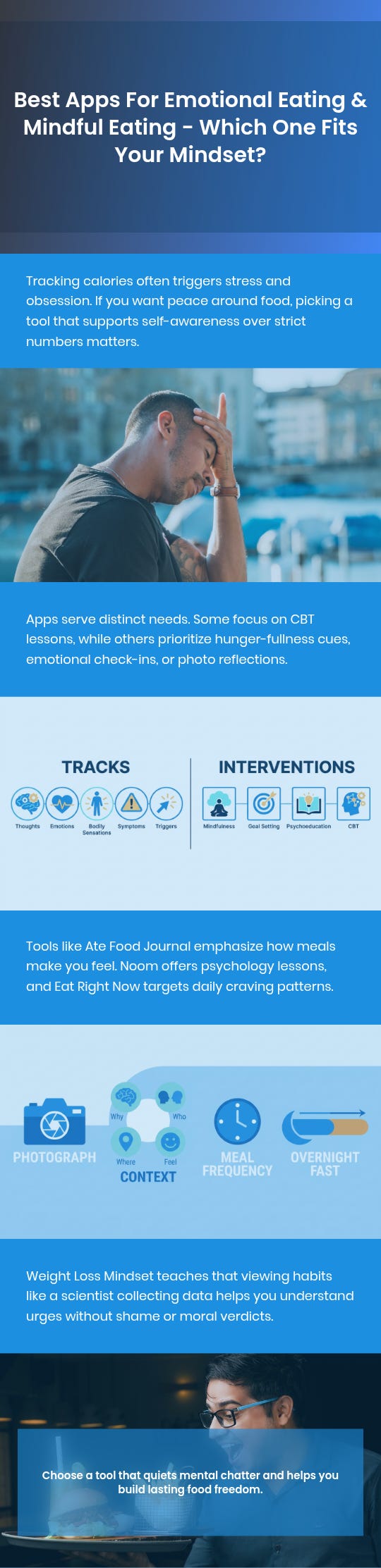
For people who want to rebuild a sense of hunger and fullness without another number to track, mindful-eating apps offer a gentler entry point. Ate Food Journal uses photo-based logging paired with questions about feelings and context, deliberately staying away from calories or macros. Am I Hungry? takes a reflection-based approach, using questions and a hunger-fullness scale to help someone examine whether a craving is coming from the stomach or from stress, boredom, or something else entirely.
MEAL, short for Mindful Eating & Living, combines education with mindful and intuitive eating practices, adding support specifically aimed at emotional or binge eating. These tools suit someone who has spent years tracking calories and wants a break from numbers while still staying engaged with their eating patterns in a structured way.
Structured Weight-Loss Psychology
For people who want a more guided, lesson-based approach to changing habits, Noom is often presented as the strongest all-around option. It combines lessons, food logging, coaching, and community features aimed at addressing the psychology behind eating decisions rather than treating food choices as a simple matter of discipline. The catch is that full features sit behind a paywall, and the app still involves a degree of calorie awareness that may not sit well with someone who has a history of restrictive eating.
Eat Right Now takes a related but distinct approach, offering daily lessons, mindfulness exercises, real-time craving tools, journaling, and community support, along with optional weight-management modules for people who want that layer added in. Both apps suit someone who wants more hand-holding than a journal provides but still wants the focus to stay on behavior and thinking patterns rather than restriction.
Straight Calorie and Nutrient Tracking
MyFitnessPal remains a familiar option for anyone who wants objective calorie and nutrient tracking, with a large food database and straightforward logging tools. For some people, that kind of concrete data genuinely helps. For others, especially anyone whose eating has become wrapped up in guilt or an all-or-nothing mindset, a numbers-first approach can end up reinforcing the exact cycle they are trying to escape.
What Each App Tracks and Misses
Photo Journals and Hunger Scales
Apps like Ate Food Journal ask questions about why, where, and with whom a meal happened, along with how it felt afterward, building a picture of eating patterns that a calorie count alone would miss entirely. Am I Hungry? adds a ten-point hunger-fullness rating scale to that picture, giving a simple but useful way to check whether an urge to eat is coming from genuine hunger or from an emotional trigger like stress or boredom.
These tools tend to miss precision. Someone who needs exact nutrition targets for a medical reason will not get that level of detail from a photo journal, and the apps are intentionally built that way. Their value sits in pattern recognition rather than measurement.
Craving Tools and Daily Lessons
Eat Right Now leans on daily lessons and real-time tools built specifically for moments when a craving hits hard, pairing mindfulness exercises with journaling and community support. This format suits someone who wants a short daily practice rather than a single long session of reflection, and the optional weight-management modules give it some flexibility for people who want that element included.
These craving-focused apps generally lack deep clinical support for more serious eating patterns. They work well for everyday stress eating and habit-building, but they are not designed to replace the kind of monitoring a recovery-focused app provides.
Recovery-Oriented Monitoring
Recovery Record and Rise Up + Recover both focus on logging food, mood, and behaviors with an eye toward recognizing patterns like skipped meals or bingeing episodes, and both include coping-skill features such as breathing or visualization exercises. Recovery Record goes a step further by allowing a connection with a treatment team, while Rise Up + Recover allows exporting a summary that can be shared with a provider.
These apps leave out, by design, a stand-alone weight-loss framework. They are not meant to replace therapy or medical guidance, and they tend to work best as a bridge between appointments rather than a substitute for them.
Building a Starting Combination
For many people, a single app rarely covers every need, and a simple combination tends to work better than searching for one perfect fit. A practical starting setup might look like this:
Use a photo-based journal like Ate Food Journal to log meals along with hunger level and emotional state before and after eating
Add a structured, lesson-based app like Noom to work through the patterns that show up in that journal, such as eating quickly, skipping meals, or reaching for food under stress
Revisit both regularly rather than abandoning them after a rough week, since the value comes from noticing patterns over time rather than from any single entry
This kind of pairing covers both sides of the equation: noticing what is happening in the moment, and building the habits and insight needed to respond differently over time. Weight Loss Mindset approaches this same idea from an identity angle, treating these kinds of tools as data-gathering aids that reveal patterns a person can then work with, rather than as a verdict on willpower or character.
Signs an App Isn’t Enough
Apps are genuinely useful for building awareness and tracking small day-to-day shifts, but certain signs point to a need for more than an app can offer. Frequent binge episodes, purging, severe restriction, an intense fear of weight gain, or eating that feels completely out of control are all signals that deserve attention from a professional rather than an app alone.
These are exactly the situations where Recovery Record and Rise Up + Recover are designed to sit alongside a clinician rather than stand in for one. Neither app claims to be a treatment on its own, and using either one in isolation when symptoms are serious misses the point of how they were built. A physician, registered dietitian, or eating-disorder specialist can assess what is actually happening and build a plan that an app can then support, rather than lead.
Apps Support, They Don’t Replace Care
The most useful way to think about any of these tools is as an aid that fits into a bigger picture, offering support and awareness without standing in for professional care when it’s needed. A journal app can reveal a pattern; a lesson-based app can help build a new habit around that pattern; a recovery-focused app can help someone stay consistent with a treatment plan between appointments.
None of them are designed to carry the full weight of a serious struggle on their own, and treating them that way sets up an unfair expectation for a piece of software.
For everyday patterns of stress eating, inconsistent habits, or simply wanting a break from counting calories, the apps covered here offer a solid starting point. For anything that feels more serious or persistent, pairing one of these tools with real support from a professional tends to produce better and safer results than relying on an app alone.
For a simple next step, consider starting with mindful eating tools that focus on patterns and awareness rather than another restrictive plan.