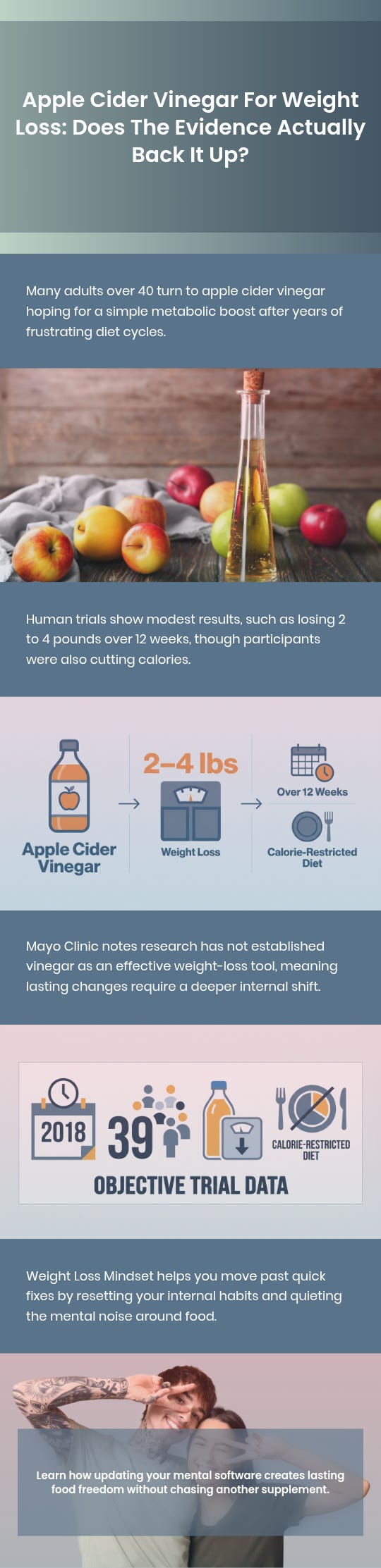
You’re told a spoonful before meals melts pounds away, but one cited trial had just 39 people already on a calorie-restricted diet. What does the actual science say about ACV and lasting weight loss?

Key Takeaways
Small studies link apple cider vinegar to roughly 2 to 4 pounds of weight loss over 12 weeks, but the research is limited and the effect is modest at best
Appetite and fullness results are mixed, with no solid proof that vinegar keeps hunger down over the long run
A widely cited 2018 trial paired vinegar with a calorie-restricted diet, so the weight changes seen cannot be pinned on vinegar alone
Long-term evidence on whether vinegar helps people keep weight off is still very thin
Diluting vinegar and watching for medication interactions matters more than most people realize before adding it to a routine
Apple cider vinegar shows up in nearly every conversation about quick weight-loss fixes, and the appeal makes sense. A spoonful before meals sounds simple, cheap, and harmless compared to another restrictive meal plan. The honest answer is more measured than the headlines suggest, and it’s worth understanding before building any habit around it.
The Short Answer on ACV
Apple cider vinegar is not a proven weight-loss treatment. A handful of small trials report modest reductions in body weight, but the research behind those numbers is limited, short in duration, and frequently muddied by other factors happening at the same time. Cleveland Clinic has described the evidence this way, noting that any benefit tends to be small and difficult to separate from everything else a person is doing differently.
That distinction matters for anyone who has spent years chasing the next supplement or trick, hoping it will finally be the missing piece. Weight Loss Mindset looks at these claims through a lens that asks what’s actually driving food choices in the first place, rather than treating a bottle of vinegar as a shortcut around that work. The vinegar itself is a minor variable. The bigger question is what role it realistically plays inside a sustainable pattern of eating.
What the Weight-Loss Studies Found
Research on apple cider vinegar and weight has produced a few encouraging numbers, but the fine print changes the picture considerably. Reading past the headline figures reveals why caution is the right response.
The Small Numbers Behind the Headlines
Some trials have reported weight losses in the range of 2 to 4 pounds over about 12 weeks, according to Cleveland Clinic. That’s a real number, but it’s also a small one, especially when stretched across three months. For context, 2 to 4 pounds sits close to what a person might lose or gain from ordinary week-to-week fluctuations in water weight, digestion, and sodium intake. Treating a number that size as proof of a breakthrough supplement overstates what the data can support.
Why a 2018 Trial Doesn’t Prove Much
A frequently cited 2018 trial involved just 39 participants, and those participants were also following a calorie-restricted diet throughout the study. That detail changes everything about how to read the results. When people eat fewer calories and also lose weight, the calorie reduction is the far more likely explanation.
With a sample that small and no way to isolate the vinegar’s individual contribution, the changes in weight and BMI reported in that trial cannot be confidently credited to vinegar at all. A separate eight-week trial conducted with Aston University, reported by BBC Food, did not find a weight-loss effect from apple cider vinegar, adding further weight to the idea that the positive findings elsewhere may not hold up under closer scrutiny.
Does It Really Curb Appetite?
One of the most common claims about apple cider vinegar is that it curbs hunger, making portion control feel effortless. The research on this point is considerably murkier than the marketing suggests.
Fullness, Nausea, and Mixed Signals
Short-term studies on appetite and fullness after drinking vinegar have produced mixed results, and no long-term appetite effect has been established. Some of the sensation people interpret as fullness may actually be something else entirely. Harvard Health Publishing has noted that the feeling of fullness some people report after drinking vinegar may come from mild nausea rather than any genuine appetite-suppressing effect. Feeling slightly sick to the stomach differs from feeling satisfied, and building a habit around discomfort rather than real satiety is unlikely to hold up over time. Harvard has also stated plainly that apple cider vinegar has not been shown to reliably reduce appetite or support weight loss on its own.
The Missing Long-Term Evidence
Perhaps the biggest gap in the research has nothing to do with short-term results at all. It has to do with what happens months or years down the road. Research on whether apple cider vinegar helps people maintain weight loss over the long term remains very limited, and the American Heart Association has gone further, stating that apple cider vinegar is not a sustainable solution to weight problems and that the small, short-term findings available should not be mistaken for proof that it resolves weight concerns.
For anyone who has already lost weight once or twice only to regain it, this gap matters more than any 12-week number. Lasting change depends on what happens in year two and year five, not what happens in the first three months, and vinegar simply has not been studied at that scale.
If You Still Want to Try It
For those who still want to experiment with apple cider vinegar, a few practical steps are worth knowing before starting. None of these turn it into a weight-loss strategy, but they help reduce the chances of an unpleasant side effect.
Dilute It or Cook With It
Drinking vinegar straight from the bottle is harsher on the body than most people realize. Mixing a small amount into a large glass of water, or using it in food such as a vinaigrette, is a gentler way to work it into a routine, as suggested by Harvard Health Publishing. The American Heart Association has offered a similar list of alternatives, including salad dressings, sauces, marinades, and pickling, all of which spread the acidity across a meal rather than concentrating it in a single swallow.
Protect Your Teeth and Digestion
Undiluted vinegar is acidic enough to erode tooth enamel over time, a concern raised by both Harvard Health Publishing and Mayo Clinic. Mayo Clinic has also noted that frequent or large amounts of vinegar can irritate the throat. The American Heart Association warns that straight vinegar can damage the esophagus and trigger upset stomach or acid reflux in some people.
Anyone prone to heartburn or gastroesophageal reflux disease should be especially cautious, and Harvard Health Publishing recommends avoiding acidic foods or drinks for 30 to 60 minutes before bed to reduce the odds of nighttime discomfort. Ohio State University Wexner Medical Center adds that vinegar taken alone may worsen symptoms for people who already deal with reflux or peptic ulcer disease.
Watch for Medication Interactions
Vinegar isn’t risk-free for everyone, particularly those managing other health conditions with medication. Mayo Clinic has noted that apple cider vinegar may interact with diuretics and insulin, potentially lowering potassium levels in people taking those medications. Anyone on prescription medication for blood sugar or fluid balance should talk with a doctor before adding regular vinegar intake to their day. Vinegar supplements sold as pills or gummies also aren’t backed by strong evidence; Ohio State University Wexner Medical Center notes that claims about these products boosting metabolism aren’t well supported by current research.
The Real Levers for Lasting Change
If a tablespoon of vinegar isn’t the answer, what actually moves the needle? The pattern that shows up again and again across credible health sources points toward the basics: overall dietary pattern, reasonable calorie balance, meals built around protein and fiber for satiety, regular movement, and sleep. None of these are flashy, and none of them fit neatly into a bottle on a kitchen shelf. They remain the factors with real evidence behind them for lasting results, rather than a handful of small, short trials with confounding variables baked in.
This is also where the deeper issue tends to live for people who have tried diet after diet. The problem was rarely a missing supplement. More often, it’s the identity patterns and automatic habit loops running underneath the day-to-day choices, the kind of thing a vinegar shot was never designed to touch in the first place.
ACV Is a Minor Habit, Not a Solution
Apple cider vinegar can be a reasonable, low-stakes habit for someone who enjoys the taste in a salad dressing or diluted drink. It falls short of a weight-loss plan, and it should never be expected to replace the slower, more durable work of building a sustainable relationship with food. The honest framing, backed by the available evidence, is that any benefit is small and uncertain at best. For anyone ready to move past quick fixes and focus on what actually drives lasting change, a structured approach to identity and habits provides a more grounded starting point than another bottle on the counter.