If you’re over 40 and tired of restrictive diets that never stick, Adele’s trainer just exposed what actually fueled her two-year transformation, and a secret diet claim doesn’t add up at all.

Key Takeaways
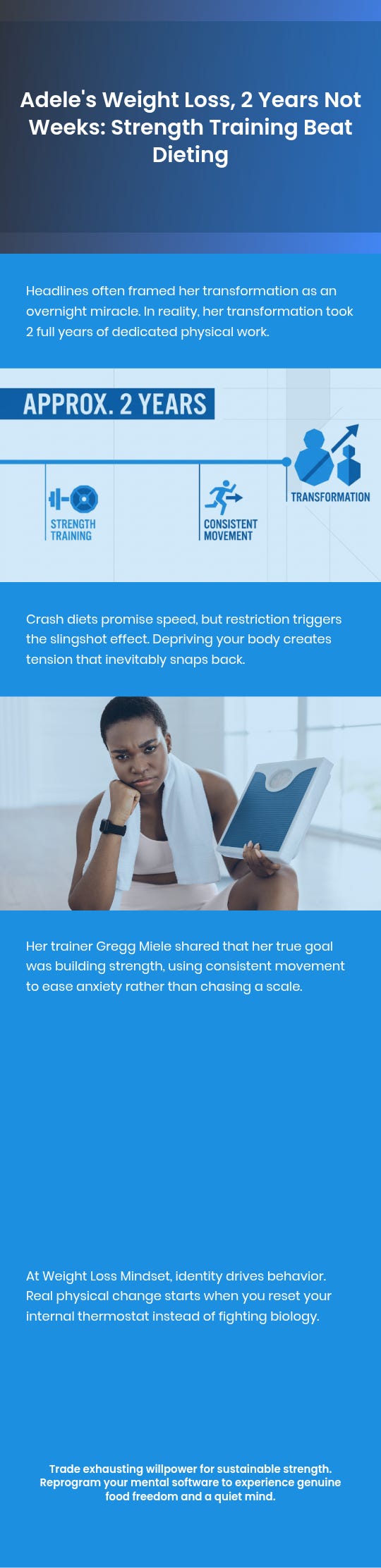
Adele’s trainer, Gregg Miele, said the real goal was getting stronger physically and mentally, with strength training and daily movement at the center, not a weight-loss target
Her body changed gradually over roughly two years, a timeline far longer than the dramatic before-and-after photos suggested
Adele has said exercise became personal time that helped her manage anxiety and panic attacks after her divorce, rather than a response to eating
She publicly denied following intermittent fasting or the Sirtfood diet, contradicting a former instructor’s claims about a restrictive eating plan
A sustainable approach to movement and identity change tends to outlast any celebrity’s exact daily schedule
Celebrity transformations tend to arrive with a built-in mystery: what’s the secret? When Adele’s changed body became public, headlines rushed to fill in that blank with diets she never followed. Her own trainer told a very different story, one with far more useful lessons for anyone over 40 who has cycled through restrictive plans and come out the other side more frustrated than before.
The Goal Was Strength, Not Weight Loss
Gregg Miele, the trainer who worked with Adele, framed the entire effort around a single idea: getting stronger, physically and mentally. That phrase matters because it reframes what success even looks like. Instead of chasing a number on a scale, the target became capability: how much she could lift, how far she could hike, how steady she felt walking into a room.
This distinction is not just semantics. For people over 40 who tie their self-worth to the scale, a stall or a setback can easily feel like personal failure. Shifting the goal toward strength and capability gives the body feedback to respond to that has nothing to do with punishment or restriction.
For anyone who has white-knuckled through a meal plan only to watch the weight return, this reframing provides a quieter kind of relief. The pressure to hit a target number fades, and what’s left is a simpler question: did movement today make someone feel more capable than yesterday?
What Her Trainer Actually Said
Getting Stronger, Physically and Mentally
Miele told Vogue that Adele “got really turned on to movement, and especially strength training,” eventually taking on double sessions. That kind of enthusiasm rarely shows up when exercise feels like a sentence to serve. It shows up when someone starts to enjoy what their body can do, and strength training in particular tends to deliver visible, trackable wins week over week that a scale cannot capture.
Multiple outlets covering her routine, including Women’s Health and Eat This, Not That!, described the same pattern: growing engagement with movement rather than gritted-teeth compliance with a program. The emotional tone of the activity shifted from obligation to interest, and that shift is often the real turning point in any long-term change.
Why It Took Two Years, Not Weeks
Adele has said the transformation unfolded over roughly two years, a detail that rarely makes it into the viral before-and-after images. Two years allows for inconsistency, for weeks that go sideways, for a body and a brain to adjust slowly instead of being forced into rapid change.
That timeline runs counter to how most transformation stories get packaged online, where thirty- or ninety-day promises dominate. A slower arc gives habits time to become identity rather than a temporary performance, which is a large part of why so many quick fixes collapse the moment the novelty wears off.
Exercise as Anxiety Relief, Not Punishment
Adele described exercise as personal time, something that helped her feel less anxious rather than something she did to earn food or atone for eating. That framing turns the usual script around: movement became a tool for emotional regulation, a place to process stress rather than a transaction tied to calories.
This matters enormously for anyone whose relationship with exercise has always been tangled up with guilt. When movement is tied to mood and mental clarity instead of punishment, it becomes something a person wants to return to, rather than something they dread and eventually abandon.
Coping With Panic Attacks After Divorce
According to reporting from TODAY and Business Insider, Adele began exercising regularly to manage anxiety and panic attacks following her divorce, and she has said she felt better when she worked out. The gym became a refuge rather than a battleground, a place where her mind could quiet down even if nothing on a plate had changed that day.
That connection between movement and mental state lines up with what many people find once they stop treating exercise purely as a weight-loss tool. The emotional payoff often arrives faster than any physical change, and it tends to be the payoff that keeps someone showing up on the days motivation runs thin.
No Secret Diet Behind the Change
Her Pandemic Routine of Weights, Hiking, and Cardio
Reports describe Adele’s pandemic-era routine as weight training in the morning, hiking or boxing in the afternoon, and cardio in the evening. It was an intensive, varied schedule built around different kinds of movement rather than a single repetitive workout, which likely kept both her body and her interest engaged over time.
Notably absent from that description is any mention of a restrictive meal plan. The emphasis across her own statements and her trainer’s account lands consistently on training and movement, not on a dramatic cut in calories.
Why a Conflicting Diet Claim Doesn’t Add Up
A former Pilates instructor once claimed that diet, including a very low daily calorie count and green juice, accounted for most of Adele’s results. That account does not match what Adele or Miele described, and Adele has publicly denied following the Sirtfood diet or intermittent fasting. When the person doing the training and the person whose body changed both point to movement rather than restriction, a secondhand claim about a secret diet carries far less weight.
What Actually Transfers to Your Own Life
Skip the Three-Workouts-a-Day Schedule
Adele herself has acknowledged that her schedule, with multiple sessions across a single day, was possible because she had trainers and an unusual amount of free time. Copying that exact routine without those same resources sets most people up for burnout rather than progress. The lesson worth keeping is not the volume of her workouts but the variety and consistency behind them.
A more realistic version might include:
One or two strength sessions a week, building gradually
Walking or hiking worked into an existing routine rather than added as a separate chore
A form of cardio that feels enjoyable rather than punishing, chosen because it fits a real schedule
Track Mood and Energy, Not Just the Scale
The scale offers one data point, and it is often a misleading one on any given day. Tracking mood, energy levels, sleep quality, or simple performance markers like how many stairs feel easy now gives a fuller picture of whether a routine is actually working. This approach treats the body as a feedback system worth studying rather than a project to control through sheer force of will, a shift worth sitting with.
Consistency Beats Any Celebrity Routine
The throughline across every account of Adele’s transformation is strength training, varied movement, two years of consistency, and an emotional motivation rooted in mental health rather than appearance, with no secret diet or miracle schedule behind it. None of that requires fame, trainers on call, or a flexible schedule to copy.
What does transfer is the underlying pattern: pick movement that feels worth returning to, let the timeline stretch longer than a few weeks, and measure progress by how capable and steady someone feels rather than by a number on a scale. For anyone ready to build that kind of sustainable, identity-driven routine, a gradual approach to lasting change tends to hold up far better than chasing anyone else’s exact schedule.