That craving that just hit you? Electrical surge, running through your nervous system faster than you can think.
Cravings aren’t random. A trigger fires (stress, boredom, a certain hour, a feeling you’d rather skip), and your brain runs a program it’s built from years of repetition. The urge shows up loud and fast: tight pull in your chest, hand already reaching for the pantry door before your mind’s caught up. And it convinces you there are only two moves: give in, or grit your teeth until you snap.
This hits harder as you get older. Metabolic and hormonal shifts sharpen cravings and make hunger cues less reliable, so “just use more willpower” fails faster than it used to, and costs more.
Give in, and tomorrow you’re right back here at the same hour, craving just as loud. White-knuckle it instead, and by dinner your willpower’s gone while the craving comes back even louder.
A circuit breaker gives you a third option. Cut the power before it takes over.
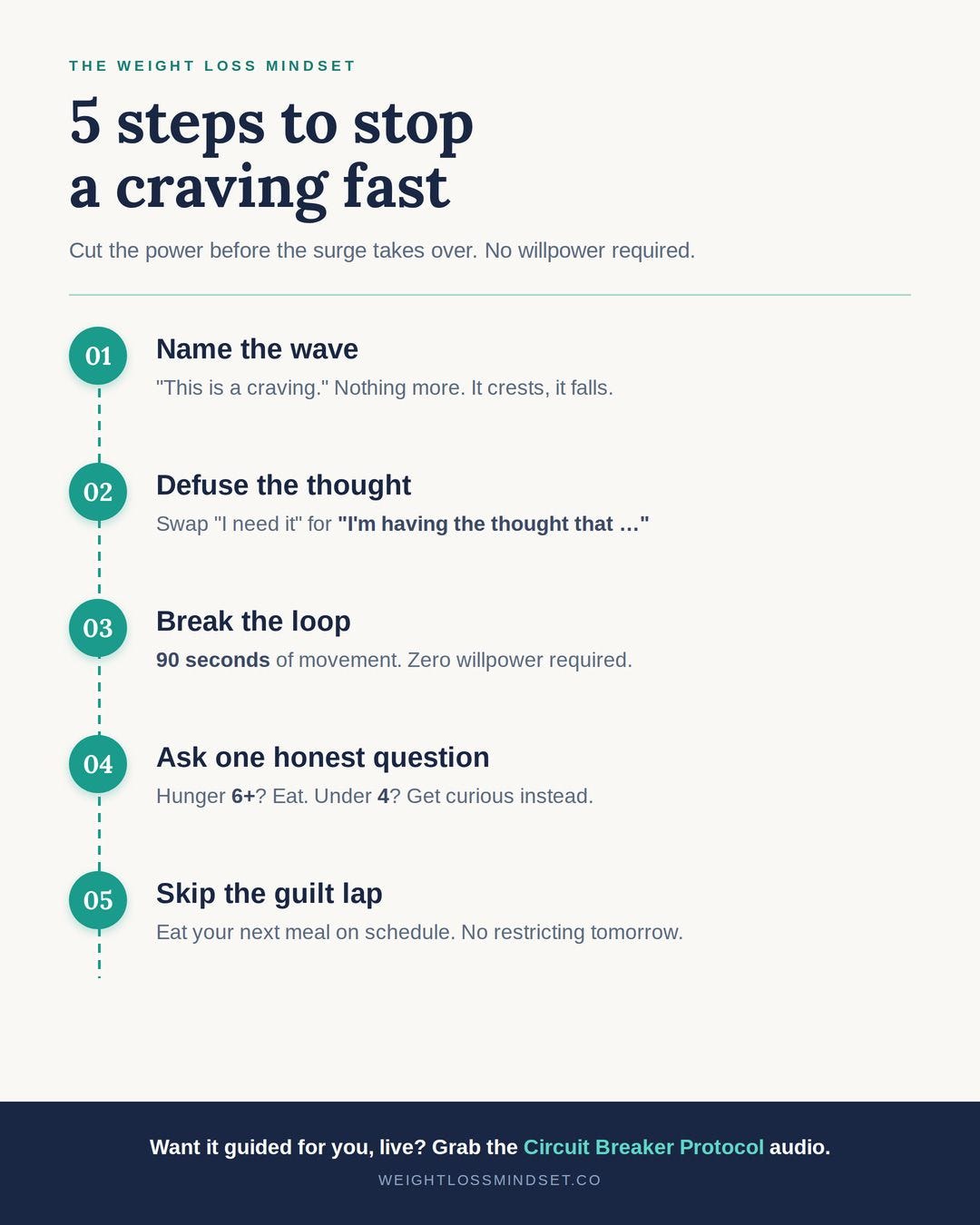
So today: the 5-step protocol I use with clients to shut off a craving in under two minutes. Zero willpower required.
Let’s cut the power.
Name the wave before it names you.
The second a craving hits, most people skip straight to negotiating with it. Should I? Shouldn’t I? Just this once?
Skip the negotiation. Say it plainly in your head: “This is a craving.” A wave, nothing more. It crests, it falls, same as every wave since the beginning of water.
Naming it moves the experience out of your amygdala (reactive, urgent, running the show) and into your prefrontal cortex, the part that can choose. One sentence, and you’ve got the wheel back before your hand ever touches the pantry door.
Defuse the thought with eight words.
Most people get stuck right here. They hear “I need chocolate” and treat it as an instruction.
It’s a thought. Thoughts you fuse with control you. Thoughts you observe don’t.
So swap the script running in your head:
Swap “I need chocolate” for “I’m having the thought that I need chocolate.”
Swap “I have to eat this right now” for “My mind is telling me I have to eat this right now.”
Swap “I can’t stop thinking about it” for “There’s a story running that says I can’t stop thinking about it.”
Eight words, and suddenly there’s distance between you and the urge. Cognitive defusion research backs this up: people who practice this separation say the craving loses its grip within seconds.
Break the loop with a 90-second pattern interrupt.
Cravings are loud. They’re also short. Most peak and fall within 90 seconds if you don’t feed them your full attention.
Give your body something automatic to do instead, something that doesn’t need willpower to sustain:
Walk to another room, or better, outside for a lap around the block
March in place, or knock out 15 jumping jacks
Call or text someone and share one true sentence about your day
Ninety seconds. That’s it. Your prefrontal cortex needs time to catch back up, and most cravings have lost half their volume by the time you’re back at your desk.
Ask your body one honest question.
Once the urge has settled, check in for real. On a scale of 1 to 10, how physically hungry are you right now?
A 6 or higher, eat. Real hunger skipped now means a bigger crash by evening.
Under a 4, get curious. A craving dressed up as hunger is usually asking for something food can’t give you: rest, connection, a break, five minutes of permission to feel bored. One of my clients used to reach for cookies every day at 3pm sharp. Turned out the honest answer was exhaustion, not hunger. A 10-minute walk beat a whole sleeve of Oreos.
Skip the guilt lap, or the pendulum swings back twice as hard.
Eat the thing anyway? What happens next decides whether it’s a one-time blip or a three-day spiral.
Restrict tomorrow to make up for it, and you’ve loaded the slingshot again. Your body reads that as a threat. Willpower runs dry by evening, and the craving comes back twice as strong.
So eat your next normal meal. On schedule. Like nothing happened. That one choice keeps the pendulum still.
PS: Want these five steps guided for you in real time? Grab the Circuit Breaker Protocol audio: five minutes long, and it walks you through the whole thing the next time a craving hits.